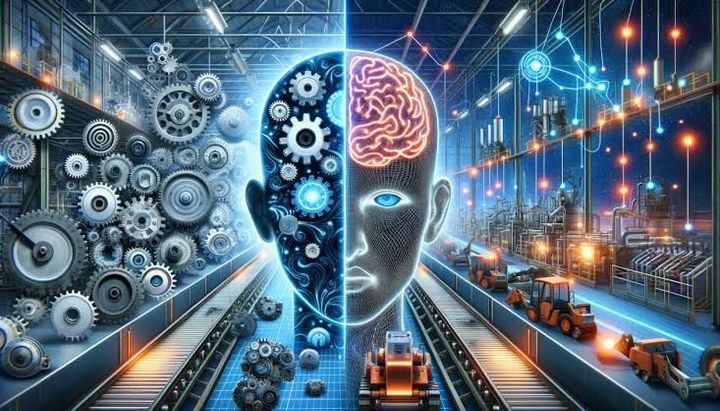
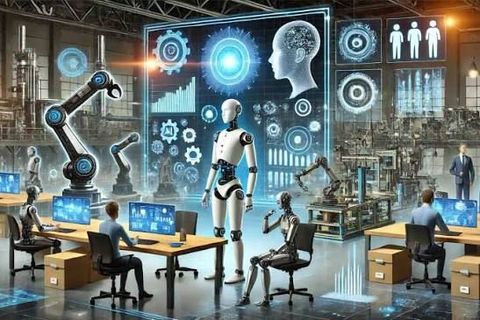
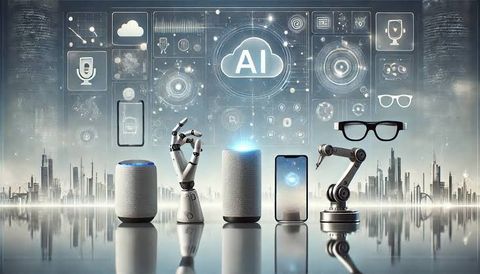
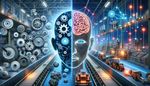
From manufacturing and logistics to healthcare, agriculture, transportation and business operations, AI in automation is becoming an important part of modern technology.
Understanding how these technologies work helps explain where AI adds value to automated processes and where conventional automation remains more appropriate.
1. What Is AI in Automation?
AI in automation refers to the integration of artificial intelligence technologies with automated machines, software systems, robots and industrial processes.
Traditional automation typically follows:
Input → Predefined Rules → Action
AI-enabled automation can introduce:
Input → Data Analysis → Prediction or Decision → Action → Feedback
This allows systems to respond to patterns, changing conditions and new information.
AI does not necessarily replace conventional automation. Instead, it can add intelligence to systems that already perform automated tasks.
2. Traditional Automation vs AI-Powered Automation
Traditional Automation
Traditional automated systems usually operate according to predefined instructions.
Examples include:
-
Timers
-
Programmable logic controllers
-
Rule-based software
-
Fixed production sequences
-
Automated conveyor systems
These systems can be highly reliable when operating conditions are predictable.
AI-Powered Automation
AI-enabled systems can analyse data and make decisions based on learned patterns.
Examples include:
-
Vision-based inspection
-
Predictive maintenance
-
Autonomous robots
-
Intelligent scheduling
-
Demand forecasting
-
Anomaly detection
The main distinction is the ability to interpret data and adapt decision-making.
3. Key Technologies Behind AI Automation
Several technologies contribute to intelligent automation.
Machine Learning
Machine learning allows systems to identify patterns in data and improve predictions based on historical information.
Deep Learning
Deep learning uses neural networks with multiple processing layers and is particularly useful for complex tasks involving images, speech and large datasets.
Computer Vision
Computer vision allows machines to interpret visual information.
Applications include:
-
Quality inspection
-
Object recognition
-
Defect detection
-
Robot guidance
-
Safety monitoring
Natural Language Processing
Natural language processing allows software systems to work with human language.
Applications include:
-
Automated document processing
-
Voice interfaces
-
Text classification
-
Intelligent assistants
-
Information extraction
Robotics
AI can provide robots with improved perception, planning and decision-making capabilities.
Edge AI
Edge AI processes information closer to where data is generated instead of sending every task to a central cloud system.
This can support applications requiring rapid responses.
4. AI in Manufacturing Automation
Manufacturing is one of the major areas where AI and automation intersect.
AI-enabled manufacturing systems can support:
-
Quality inspection
-
Production monitoring
-
Predictive maintenance
-
Process optimisation
-
Robotic operations
-
Demand forecasting
-
Production scheduling
Computer vision, for example, can inspect products and identify visual patterns that may indicate defects.
5. AI-Powered Quality Inspection
Automated inspection systems can use cameras, sensors and machine-learning models to analyse products.
A simplified workflow is:
Camera → Image Capture → AI Analysis → Classification → Automated Response
Possible applications include identifying:
-
Surface defects
-
Incorrect assembly
-
Missing components
-
Shape variations
-
Packaging problems
The system's performance depends heavily on training data, image quality, lighting and model design.
6. Predictive Maintenance
Traditional maintenance often follows either fixed schedules or reactive repairs.
AI can introduce predictive maintenance by analysing machine data to identify patterns associated with potential failures.
Inputs may include:
-
Temperature
-
Vibration
-
Pressure
-
Motor current
-
Operating cycles
-
Historical maintenance records
The objective is to identify unusual behaviour early enough for appropriate maintenance planning.
7. AI in Industrial Robotics
AI can enhance robotic systems by improving their ability to perceive and respond to their surroundings.
Potential applications include:
-
Object recognition
-
Robot navigation
-
Automated sorting
-
Adaptive gripping
-
Assembly
-
Material handling
Traditional robots often perform highly structured repetitive movements, while AI-enabled robots can be designed for more variable environments.
8. Collaborative Robots and AI
Collaborative robots, often called cobots, are designed to operate in environments where people and robots may work in close proximity.
AI can support capabilities such as:
-
Object recognition
-
Motion planning
-
Adaptive task execution
-
Vision-guided operations
The exact safety characteristics depend on the robot, application and system configuration.
9. AI in Logistics Automation
Logistics systems generate large amounts of data, making them suitable for AI-based optimisation.
Applications include:
-
Warehouse robotics
-
Route optimisation
-
Automated sorting
-
Inventory forecasting
-
Demand prediction
-
Package classification
AI can help coordinate multiple variables that would be difficult to manage through simple fixed rules.
10. AI in Warehouses
AI-enabled warehouse automation can combine:
-
Robots
-
Sensors
-
Cameras
-
Inventory software
-
Machine-learning models
A warehouse system might analyse inventory information and automatically prioritise movement of specific items.
This creates a connected workflow between physical automation and digital decision-making.
11. AI in Transportation
AI and automation are increasingly connected in transportation systems.
Potential applications include:
-
Traffic prediction
-
Driver assistance
-
Fleet optimisation
-
Route planning
-
Autonomous navigation
-
Predictive maintenance
Fully autonomous transportation remains a complex field because real-world environments contain unpredictable conditions.
12. AI in Healthcare Automation
Healthcare organisations can use AI-enabled automation for administrative, diagnostic-support and operational processes.
Applications may include:
-
Medical image analysis
-
Appointment scheduling
-
Document processing
-
Laboratory automation
-
Patient-flow optimisation
-
Equipment monitoring
AI systems used in healthcare require appropriate validation, oversight and consideration of clinical safety.
13. AI in Laboratory Automation
Laboratories increasingly use automation to process samples and manage workflows.
AI can potentially support:
-
Image analysis
-
Sample classification
-
Anomaly detection
-
Workflow optimisation
-
Data interpretation
-
Predictive maintenance
Combining robotics, laboratory information systems and AI can create more connected laboratory workflows.
14. AI in Agriculture
Agricultural automation can combine AI with sensors, robotics and imaging technologies.
Applications include:
-
Crop monitoring
-
Plant disease detection
-
Automated irrigation
-
Precision spraying
-
Yield prediction
-
Autonomous agricultural machinery
Computer vision can help identify differences between healthy and unhealthy plants.
15. AI in Energy Management
AI can support automation in energy systems by analysing consumption and operating data.
Applications include:
-
Demand forecasting
-
Grid monitoring
-
Equipment maintenance
-
Energy optimisation
-
Building automation
-
Renewable-energy forecasting
Intelligent systems can identify patterns that may help organisations manage energy use more effectively.
16. AI in Smart Buildings
AI-enabled building automation can coordinate systems such as:
-
Heating
-
Cooling
-
Lighting
-
Security
-
Ventilation
-
Energy monitoring
Instead of operating only according to fixed schedules, intelligent systems can analyse occupancy and environmental conditions to adjust certain operations.
17. AI in Business Process Automation
AI is not limited to physical machines.
In business environments, AI can automate information-based tasks such as:
-
Document classification
-
Data extraction
-
Workflow routing
-
Customer communication
-
Report generation
-
Data validation
This is often referred to as intelligent process automation.
18. Robotic Process Automation and AI
Robotic process automation, or RPA, traditionally automates repetitive software-based tasks.
AI can extend RPA by helping systems work with less structured information.
For example:
Document → AI Extraction → Data Validation → Workflow Automation
This can be useful when information comes in different formats.
19. Generative AI and Automation
Generative AI can produce or transform content such as:
-
Text
-
Images
-
Code
-
Summaries
-
Structured information
When connected with automation platforms, generative AI can help interpret natural-language instructions and generate outputs that trigger downstream workflows.
However, human review may remain important for tasks involving sensitive or high-impact decisions.
20. AI Agents and Automation
AI agents are designed to perform multi-step tasks using reasoning, tools and data.
A simplified automated agent workflow can be:
Goal → Planning → Tool Use → Evaluation → Next Action
This differs from traditional automation, which generally follows a predetermined sequence.
Agentic automation is still an evolving area and requires careful attention to reliability, permissions and oversight.
21. Sensors and AI Automation
Sensors provide the data that intelligent automation systems need.
Common sensor types include:
-
Temperature sensors
-
Pressure sensors
-
Proximity sensors
-
Motion sensors
-
Cameras
-
Vibration sensors
-
Position sensors
AI models can analyse these inputs to identify patterns or make predictions.
22. Internet of Things and AI
The Internet of Things connects physical devices to digital networks.
Combining IoT with AI creates a system often described as AIoT — Artificial Intelligence of Things.
A typical architecture can involve:
Sensors → Network → Data Platform → AI Model → Decision → Automated Action
This architecture can support applications ranging from factories to buildings and transportation systems.
23. Cloud AI vs Edge AI
Cloud AI
Data is processed using remote computing infrastructure.
Potential advantages include:
-
Large computing resources
-
Centralised data management
-
Easier model deployment at scale
Edge AI
Data is processed closer to the physical device.
Potential advantages include:
-
Lower latency
-
Reduced dependence on network connectivity
-
Faster local responses
-
Greater control over certain data flows
The appropriate approach depends on application requirements.
24. Benefits of AI in Automation
AI-enabled automation can provide several potential advantages.
Improved Efficiency
Automated systems can perform repetitive processes consistently.
Better Decision Support
AI can identify patterns across large datasets.
Predictive Capabilities
Machine-learning models can identify signals associated with future events.
Improved Quality Monitoring
Computer vision and automated inspection can analyse products consistently.
Scalability
Digital automation can potentially handle increasing volumes of information without proportional increases in manual processing.
Faster Responses
Automated systems can respond to certain events in real time.
25. Limitations and Challenges
AI automation also presents challenges.
Data Quality
Poor or incomplete data can reduce model performance.
Integration
Connecting AI systems with existing equipment and software can be technically complex.
Cybersecurity
Connected automation systems can create additional cybersecurity considerations.
Model Reliability
AI predictions are not guaranteed to be correct.
Infrastructure
Advanced automation may require appropriate computing, networking and sensor infrastructure.
Skills
Organisations may need employees with expertise in AI, automation, engineering, cybersecurity and data management.
26. AI Automation and Cybersecurity
As automated systems become connected, cybersecurity becomes increasingly important.
Potential safeguards include:
-
Access controls
-
Network segmentation
-
Device authentication
-
Software updates
-
Data protection
-
Monitoring
-
Incident-response procedures
Security should be considered during system design rather than added only after deployment.
27. Data Quality and AI Performance
AI systems depend heavily on the quality of their input data.
Important characteristics include:
-
Accuracy
-
Completeness
-
Relevance
-
Consistency
-
Timeliness
Training data should also represent the conditions in which the system will operate.
Poorly representative data can produce unreliable predictions.
28. Human Oversight
AI automation does not eliminate the need for people in every application.
Human oversight may be necessary for:
-
Safety-critical decisions
-
Healthcare applications
-
Financial processes
-
Complex industrial operations
-
Unusual system behaviour
The appropriate level of human involvement depends on the consequences of incorrect decisions.
29. AI Automation Architecture
A typical AI automation system may contain several layers.
Physical Layer
Machines, robots and sensors collect information.
Connectivity Layer
Networks transfer data between devices and systems.
Data Layer
Data is stored, processed and prepared for analysis.
AI Layer
Machine-learning or other AI models analyse information.
Automation Layer
Decisions are translated into automated actions.
Monitoring Layer
Performance is monitored and evaluated.
This layered structure helps organisations understand where different technologies fit within an automated environment.
30. Digital Twins and AI
A digital twin is a digital representation of a physical asset, system or process.
When combined with AI, digital twins can support:
-
Performance analysis
-
Simulation
-
Predictive maintenance
-
Process optimisation
-
Scenario modelling
For example, a digital representation of a production line can be used to analyse potential changes before modifying the physical system.
31. AI in Industrial Internet of Things
Industrial IoT connects machines, sensors and industrial systems.
AI can analyse the resulting data for:
-
Equipment monitoring
-
Process optimisation
-
Failure prediction
-
Production analysis
-
Energy management
This combination is an important component of modern industrial automation.
32. AI in Autonomous Systems
Autonomous systems are designed to perform tasks with limited direct human control.
Examples can include:
-
Autonomous mobile robots
-
Drones
-
Automated vehicles
-
Robotic inspection systems
These systems typically combine sensors, perception, planning and control technologies.
33. AI Automation in Quality Control
Quality control can benefit from AI because automated systems can inspect large numbers of products consistently.
A typical workflow might be:
Product → Sensor or Camera → AI Model → Quality Classification → Action
Depending on the application, the automated action could involve:
-
Accepting an item
-
Flagging an item
-
Sending an item for additional inspection
-
Recording quality information
34. AI Automation in Supply Chains
AI can analyse multiple supply-chain variables simultaneously.
Potential applications include:
-
Demand forecasting
-
Inventory optimisation
-
Supplier analysis
-
Route planning
-
Warehouse automation
-
Disruption prediction
The objective is to improve visibility and decision-making across interconnected operations.
35. Future of AI in Automation
Several developments are likely to influence the next generation of intelligent automation.
More Adaptive Robots
Robots are becoming increasingly capable of operating in less structured environments.
AI-Powered Vision
Vision systems are becoming more capable of recognising objects, patterns and anomalies.
Edge Intelligence
More AI processing is moving closer to sensors and machines.
Digital Twins
AI-powered simulation can support increasingly complex operational planning.
Human-AI Collaboration
Automation is increasingly being designed to support people rather than simply replace manual tasks.
Autonomous Decision Systems
Some systems are moving toward greater autonomy in planning and operational decisions.
36. How to Approach AI Automation
Organisations considering AI automation can follow a structured process.
Step 1: Identify the Process
Choose a process with measurable repetitive or data-intensive activities.
Step 2: Understand the Data
Determine what information is available and whether it is suitable for AI.
Step 3: Define the Objective
Establish measurable goals such as quality improvement, faster processing or predictive capability.
Step 4: Evaluate Existing Infrastructure
Review machines, sensors, software and connectivity.
Step 5: Select the Appropriate Technology
Not every process requires AI. Conventional automation may be more appropriate when rules are predictable.
Step 6: Test the System
Use a controlled pilot before wider deployment.
Step 7: Monitor Performance
Evaluate accuracy, reliability, safety and operational outcomes.
Step 8: Improve Continuously
AI systems should be monitored and updated as operating conditions change.
FAQs
What is AI in automation?
AI in automation combines artificial intelligence with machines, software and automated systems to analyse data, recognise patterns, make predictions or support automated decisions.
How is AI different from traditional automation?
Traditional automation generally follows predefined rules, while AI-enabled automation can analyse data and adapt decisions based on learned patterns.
Where is AI automation used?
It is used across manufacturing, logistics, healthcare, agriculture, energy, transportation, business processes, robotics and smart buildings.
What technologies are used in AI automation?
Common technologies include machine learning, deep learning, computer vision, natural language processing, robotics, IoT, edge computing and digital twins.
Can AI automation work without human involvement?
Some systems can operate autonomously within defined conditions, but human oversight remains important for many complex, safety-critical or high-impact applications.
Conclusion
AI in automation represents the combination of intelligent data analysis with automated physical or digital processes.
Machine learning, computer vision, robotics, IoT, edge computing and digital twins are helping automated systems move beyond fixed instructions toward more adaptive and data-driven operations.
The most effective approach is not necessarily to make every process intelligent. Instead, organisations should identify where AI can provide meaningful capabilities such as prediction, recognition, optimisation or adaptive decision-making.
As AI technology develops, automation is likely to become more connected, adaptive and collaborative. The future will increasingly involve systems where machines collect information, AI interprets it, automation responds and people provide oversight where judgement remains essential.
Disclaimer
This article is intended for general educational and informational purposes only. AI and automation technologies vary significantly by application, industry, equipment and operating environment. The information provided does not constitute technical, engineering, cybersecurity, safety or professional advice and does not recommend any specific technology, platform, manufacturer or system. Organisations should evaluate applicable standards, regulations, security requirements, manufacturer documentation and professional guidance before implementing AI-enabled automation.