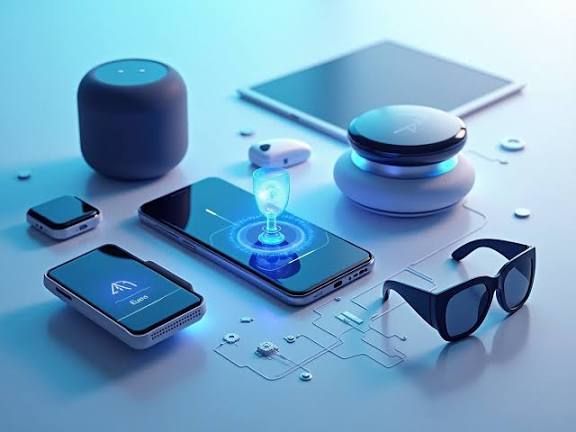
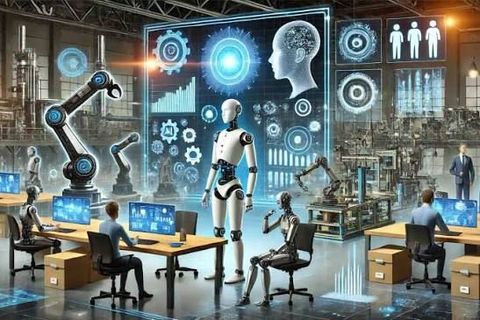
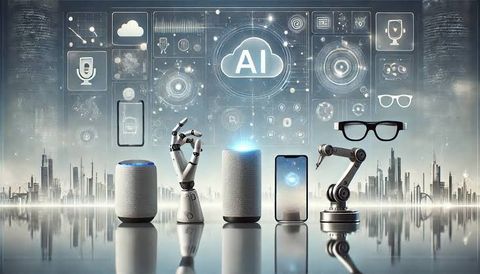
Modern AI hardware combines processors, sensors, memory, connectivity and specialised AI accelerators to perform intelligent tasks. Intel identifies CPUs, GPUs, TPUs, NPUs, FPGAs and memory technologies as important components within modern AI hardware systems.
One of the biggest developments is Edge AI, where AI processing takes place on or near the device generating the data. This can support faster responses and reduce dependence on continuous cloud processing.
1. What Are AI-Powered Devices?
AI-powered devices are physical electronic or computing systems that use artificial intelligence technologies to analyse information and perform defined intelligent tasks.
Depending on their design, these devices can:
-
Recognise images and objects
-
Understand speech
-
Analyse sensor data
-
Detect unusual patterns
-
Generate or interpret content
-
Predict specific outcomes
-
Automate repetitive activities
-
Respond to environmental changes
Examples include:
-
AI PCs and laptops
-
Smartphones
-
Smart cameras
-
Smart speakers
-
Wearables
-
Robots
-
Drones
-
Intelligent sensors
-
Autonomous systems
-
Industrial equipment
The level of intelligence varies significantly from one device to another.
2. How AI-Powered Devices Work
Most AI-powered devices combine several technological layers.
Sensors
Sensors capture information from the surrounding environment.
Common examples include:
-
Cameras
-
Microphones
-
Motion sensors
-
Temperature sensors
-
Pressure sensors
-
Accelerometers
-
Radar sensors
-
Location sensors
Processing Hardware
The captured information is processed by computing hardware such as CPUs, GPUs, NPUs or other accelerators.
AI Models
AI models interpret the information and produce an output.
For example:
Camera → AI Model → Object Recognition → Device Response
Connectivity
Depending on the device, information can be exchanged through:
-
Wi-Fi
-
Bluetooth
-
Cellular networks
-
Local networks
-
IoT systems
-
Cloud platforms
Output
The device can then provide an output through:
-
Screen
-
Speaker
-
Notification
-
Mechanical movement
-
Automated control
-
Data dashboard
3. Major Types of AI-Powered Devices
AI-powered technology exists across many categories.
AI PCs and Laptops
AI PCs incorporate dedicated hardware designed to support AI workloads. Intel describes modern AI PCs as systems combining CPUs, GPUs and integrated NPUs to support AI applications locally.
Potential applications include:
-
AI assistants
-
Voice processing
-
Image editing
-
Video enhancement
-
Background effects
-
Transcription
-
Local AI applications
Smartphones
Smartphones use AI for many everyday functions.
Examples include:
-
Computational photography
-
Voice recognition
-
Translation
-
Image enhancement
-
Personalisation
-
Security features
-
Generative AI functions
Smart Cameras
AI-enabled cameras can analyse visual information rather than simply recording it.
They can be used for:
-
Object detection
-
People counting
-
Traffic monitoring
-
Quality inspection
-
Pattern recognition
-
Safety monitoring
Wearable Devices
Smartwatches, smart glasses and other wearables can use AI to interpret information collected from sensors.
Potential applications include:
-
Activity recognition
-
Voice interaction
-
Personalised insights
-
Environmental awareness
-
Sensor-data analysis
Smart Home Devices
AI can be integrated into:
-
Smart speakers
-
Smart thermostats
-
Smart appliances
-
Smart lighting
-
Home cameras
-
Security sensors
These devices can interpret commands and recognise usage patterns.
Robots
AI-powered robots combine sensors, processors and software to perceive their environment and perform specific tasks.
Applications include:
-
Manufacturing
-
Logistics
-
Inspection
-
Research
-
Healthcare
-
Agriculture
Drones
AI can allow drones to process camera and sensor information for applications such as:
-
Object detection
-
Navigation
-
Mapping
-
Infrastructure inspection
-
Agricultural monitoring
Intelligent Industrial Equipment
Factories can use AI-enabled equipment for:
-
Predictive maintenance
-
Quality inspection
-
Process monitoring
-
Robotics
-
Anomaly detection
-
Production optimisation
4. AI Processors Explained
AI performance depends heavily on the underlying hardware.
CPU
The Central Processing Unit handles general-purpose computing and system management.
GPU
Graphics Processing Units are highly effective at parallel processing and can handle demanding AI workloads.
NPU
A Neural Processing Unit is specifically designed to accelerate neural-network workloads, particularly AI inference on devices.
NPUs can help AI PCs and mobile devices process selected workloads locally while using less power than some alternative approaches.
TPU
Tensor Processing Units are specialised processors designed around machine-learning workloads and are particularly associated with large-scale AI infrastructure.
FPGA
Field-Programmable Gate Arrays can be configured for specialised workloads and are useful where flexibility and real-time processing are important.
5. What Is Edge AI?
Edge AI means running AI models closer to where data is generated rather than sending every task to a central cloud environment.
For example:
Smart Camera → Local AI Processing → Detection → Immediate Action
Instead of:
Smart Camera → Cloud → Processing → Response
Edge AI can support:
-
Lower latency
-
Faster responses
-
Reduced bandwidth requirements
-
Local processing
-
Greater operational independence
Research published in 2026 describes Edge AI as an evolving combination of specialised hardware, lightweight AI architectures and deployment software designed to bring machine-learning computation closer to data sources.
6. Why On-Device AI Matters
On-device AI can be useful when information needs to be processed quickly.
For example, a camera detecting an object does not necessarily need to send every frame to a remote server before generating a local response.
Potential advantages include:
Faster Response
Processing data locally can reduce communication delays.
Lower Cloud Dependency
Selected workloads can continue operating without constant communication with a remote server.
Data Locality
Sensitive information may remain on the device for certain workloads.
Lower Bandwidth Requirements
Only selected information may need to be transmitted rather than all raw data.
Energy Efficiency
Specialised AI processors can be designed to perform particular workloads efficiently.
These benefits depend on hardware, model architecture, software optimisation and the specific deployment environment.
7. Key Features of AI-Powered Devices
Several features commonly distinguish AI-enabled hardware from conventional electronics.
Computer Vision
The device can interpret visual information from cameras or other imaging sensors.
Speech Recognition
AI can convert spoken language into machine-readable information.
Natural-Language Processing
Devices can interpret and respond to human language.
Pattern Recognition
AI can identify recurring or unusual patterns within data.
Predictive Analysis
Models can estimate likely outcomes based on available information.
Local Inference
AI models can execute directly on the device or nearby edge hardware.
Automation
AI can trigger defined actions based on detected conditions.
Personalisation
Some devices can adapt selected functions according to usage patterns or preferences.
8. AI-Powered Devices in Healthcare
AI-enabled devices are increasingly relevant to healthcare technology.
Potential applications include:
-
Patient monitoring
-
Medical imaging analysis
-
Wearable monitoring
-
Equipment monitoring
-
Remote observation
-
Automated data analysis
AI systems used in healthcare require appropriate validation, security controls, regulatory oversight and professional supervision.
9. AI in Manufacturing
Manufacturing is an important environment for AI-powered devices.
Predictive Maintenance
Sensors can monitor vibration, temperature and other machine characteristics to identify unusual patterns.
Visual Inspection
AI cameras can identify product defects and inconsistencies.
Robotics
AI can help robots interpret sensor information and operate within defined environments.
Process Monitoring
Industrial AI systems can continuously analyse production information and identify anomalies.
Edge AI is particularly relevant when manufacturing decisions need to happen close to machinery.
10. AI in Transportation
Transportation systems can use AI-powered devices for:
-
Driver assistance
-
Object detection
-
Traffic monitoring
-
Navigation
-
Fleet monitoring
-
Vehicle diagnostics
-
Autonomous systems
Vehicles can combine cameras, radar, lidar and other sensors with AI processors to interpret their surroundings.
Because transportation can involve safety-critical decisions, system reliability and validation are particularly important.
11. AI in Retail
AI-powered cameras and sensors can support retail environments through applications such as:
-
Inventory monitoring
-
Product recognition
-
Footfall analysis
-
Shelf monitoring
-
Automated checkout systems
-
Operational analytics
Local processing can be useful where rapid visual analysis is required.
12. AI in Agriculture
AI devices can help analyse agricultural conditions using cameras, sensors, drones and connected equipment.
Applications include:
-
Crop monitoring
-
Soil analysis
-
Pest detection
-
Irrigation monitoring
-
Agricultural robotics
-
Equipment monitoring
-
Field imaging
AI can help transform large amounts of sensor and image data into actionable information.
13. AI in Smart Homes
Smart-home devices increasingly combine AI with sensors and connectivity.
For example, an intelligent thermostat can analyse environmental information and usage patterns, while an AI-enabled camera can interpret selected visual events.
Other examples include:
-
Voice assistants
-
Smart lighting
-
Intelligent appliances
-
Security cameras
-
Environmental sensors
The objective is generally to make connected environments more responsive and automated.
14. AI in Robotics
Robotics is one of the clearest examples of AI moving into the physical world.
A modern robot may combine:
Sensors + AI Processor + AI Model + Motion System + Control Software
The sensors provide information about the environment, while the AI system interprets that information and helps determine the appropriate response.
Applications include:
-
Industrial automation
-
Warehouse robotics
-
Inspection
-
Agriculture
-
Healthcare research
-
Autonomous machines
15. AI-Powered Devices and Generative AI
Generative AI is also moving toward smaller and more efficient device-based models.
Smaller language models can make certain AI functions practical on local hardware rather than requiring every request to be processed in a data centre. IBM identifies the growth of smaller language models as one factor expanding what edge devices can perform locally.
Potential applications include:
-
Local AI assistants
-
Voice interaction
-
Text summarisation
-
Image enhancement
-
Translation
-
Personalised device functions
The exact capabilities depend on the device's processor, memory, software and AI model.
16. Benefits of AI-Powered Devices
Faster Processing
Local inference can reduce the time needed to transmit data to remote infrastructure.
Greater Automation
AI can automate defined detection and decision-support tasks.
Improved Responsiveness
Devices can respond rapidly to sensor information.
Reduced Data Transmission
Some raw information can be processed locally.
Offline Capability
Certain AI functions may continue operating when internet access is unavailable.
Energy Efficiency
Purpose-built accelerators can improve efficiency for specific AI workloads.
Personalised Experiences
AI can adapt selected functions to user behaviour and preferences.
17. Challenges of AI-Powered Devices
AI-enabled hardware also presents several challenges.
Hardware Limitations
Compact devices have limited processing power, memory and energy capacity.
Heat
Continuous AI workloads can create thermal-management challenges.
Battery Consumption
More intensive processing can increase energy use.
Model Size
Large AI models may be difficult to run locally.
Security
Connected intelligent devices can introduce additional cybersecurity risks.
Privacy
Cameras, microphones and other sensors may collect sensitive information.
Accuracy
AI systems can make incorrect predictions or classifications.
Software Dependency
AI hardware requires compatible models, frameworks and software optimisation to perform effectively.
18. AI Performance: Why Hardware Alone Is Not Enough
A common misconception is that a device with a higher AI-performance rating will always be better.
AI performance also depends on:
-
Model architecture
-
Software optimisation
-
Memory bandwidth
-
Processor design
-
Thermal management
-
Power limits
-
Application workload
For example, NPU performance is sometimes measured using TOPS, meaning trillions of operations per second. However, TOPS alone does not determine real-world AI performance. Hardware integration and software optimisation also matter.
19. Cloud AI vs Device AI
Both approaches have different strengths.
| Cloud AI | Device AI |
|---|
| Large computing resources | Local processing |
| Suitable for complex workloads | Useful for selected local workloads |
| Strong centralised infrastructure | Lower dependency on cloud |
| Requires network communication for cloud tasks | Can support offline operation |
| Centralised model management | Local inference |
| Useful for large-scale analytics | Useful for low-latency applications |
Many modern systems use a hybrid architecture rather than choosing only one approach.
20. Hybrid AI Architecture
A hybrid AI system can divide workloads between devices and cloud infrastructure.
A simplified architecture looks like:
Device → Edge Processing → Cloud Platform
The device can handle immediate inference while the cloud manages larger-scale functions such as:
-
Model training
-
Centralised analytics
-
Data storage
-
Model updates
-
Fleet management
This approach can balance local responsiveness with centralised computing resources.
21. How AI Devices Are Becoming Smarter
Several technological developments are pushing AI devices forward.
Better AI Accelerators
New generations of NPUs and other processors are increasing local AI capabilities.
Smaller Models
Model compression and efficient architectures allow more AI functions to run on limited hardware.
Better Sensors
Improved cameras, radar, microphones and other sensors provide richer data.
Improved Connectivity
Modern wireless technologies allow devices to communicate efficiently when cloud or edge coordination is required.
Better Software Optimisation
AI frameworks and deployment tools make it easier to adapt models for different hardware.
Arm, for example, provides processors and NPUs designed to support AI inference on low-power, resource-constrained devices.
22. Future of AI-Powered Devices
The future of AI hardware is increasingly connected to the idea of Physical AI—intelligence embedded into machines and physical infrastructure.
Recent industry analysis describes this shift as AI moving beyond digital interfaces into areas such as manufacturing, healthcare and transportation, with more decisions occurring at the network edge.
Important future developments may include:
-
More capable AI PCs
-
Smaller AI models
-
Advanced wearable AI
-
Intelligent sensors
-
Autonomous robots
-
AI-enabled industrial machinery
-
More capable smart cameras
-
AI-enabled vehicles
-
Local generative AI
-
More efficient AI processors
The overall direction is clear: intelligence is increasingly moving closer to the physical environment where data is created and actions occur.
23. What to Consider When Evaluating an AI Device
When researching an AI-powered device, look beyond the word "AI."
Processor
Check whether the device uses a CPU, GPU, NPU or another accelerator.
AI Capability
Understand which AI workloads it can actually perform.
Memory
Check memory capacity and bandwidth for the intended workload.
Connectivity
Determine which functions require internet or cloud access.
Privacy
Review what information the device collects and where it is processed.
Battery
For portable devices, energy efficiency is particularly important.
Software
Check compatibility with the applications and AI models you intend to use.
Updates
Determine whether the manufacturer provides ongoing firmware and software support.
24. AI-Powered Devices: Key Takeaways
The most important concepts can be summarised simply:
-
AI hardware provides the computing foundation.
-
Sensors collect information.
-
AI models interpret information.
-
NPUs and other accelerators can improve local AI processing.
-
Edge AI brings computation closer to where data is generated.
-
Cloud AI remains important for large-scale workloads.
-
Hybrid architectures combine local and centralised processing.
-
Robotics and autonomous systems demonstrate AI's transition into the physical world.
-
Efficient models are making local AI increasingly practical.
FAQs
What are AI-powered devices?
AI-powered devices are physical systems that use artificial intelligence to analyse information, recognise patterns, generate outputs or perform defined tasks. Examples include AI PCs, smartphones, smart cameras, wearables, robots and intelligent industrial equipment.
What is an NPU in an AI device?
An NPU, or Neural Processing Unit, is specialised hardware designed to accelerate certain AI workloads. NPUs are increasingly integrated into PCs and mobile devices for efficient on-device AI processing.
What is Edge AI?
Edge AI refers to running AI models on local devices or nearby edge computing infrastructure instead of relying entirely on centralised cloud processing. It can provide faster responses and reduce the amount of data that needs to travel to the cloud.
Where are AI-powered devices used?
AI-powered devices are used across consumer electronics, healthcare, manufacturing, transportation, agriculture, retail, smart homes, robotics and industrial environments.
Are AI-powered devices dependent on the internet?
Not always. Some AI functions can run directly on the device through local processing. Other functions may require cloud connectivity, depending on the model, application and device architecture.
Conclusion
AI-powered devices represent an important evolution in computing. Instead of treating artificial intelligence as something that exists only inside cloud applications, modern technology increasingly places AI directly into computers, cameras, sensors, vehicles, wearables, robots and industrial systems.
The combination of specialised processors, efficient AI models, better sensors and Edge AI is making local intelligence more practical.
The next stage is likely to be even more physical: devices that can sense their environment, understand information and respond in real time. This shift toward intelligent physical systems could influence how people interact with technology across homes, workplaces, transportation and industry.
Disclaimer
This article is provided for general educational and informational purposes only. It does not constitute technical, financial, medical, legal or professional advice and does not endorse any specific AI device, technology or manufacturer. AI hardware, software capabilities, specifications, applications and industry developments can change rapidly. Readers should verify technical specifications, privacy policies, security information and regulatory requirements through appropriate official sources before making technology-related decisions.