Artificial Intelligence Products Guide: Types, Uses & Technology Insights
Artificial intelligence is becoming an important part of modern software, computing devices, industrial systems, business operations, and everyday digital experiences. AI technologies can analyse information, recognise patterns, understand language, generate content, make predictions, and support automated workflows.
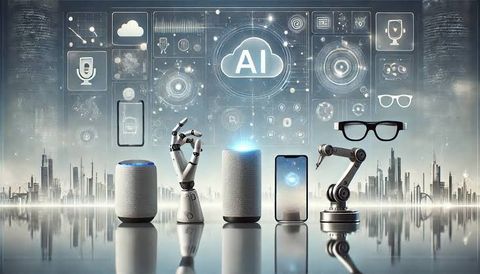
An artificial intelligence product is a software application, hardware device, platform, or integrated system that incorporates one or more AI technologies. These products can range from AI assistants and productivity applications to smart cameras, robotics platforms, AI-enabled computers, analytics systems, and specialised industry technologies.
Understanding the different types of artificial intelligence products helps explain how AI is being developed and applied across different sectors.
What Are Artificial Intelligence Products?
Artificial intelligence products are technologies designed to perform tasks using computational models that can learn from data, identify patterns, interpret information, or generate outputs.
Depending on their purpose, AI products may use:
- Machine learning
- Deep learning
- Generative AI
- Natural language processing
- Computer vision
- Speech recognition
- Predictive analytics
- Recommendation systems
- Robotics
- AI agents
Some products use a single AI capability, while others combine several technologies.
How AI Products Work
Although architectures differ, a simplified AI workflow can be represented as:
Data or Input → AI Model → Processing → Output → User or System Action
For example, an AI vision system may receive an image, identify objects within it, and produce a classification or detection result.
A generative AI system may receive a written instruction and generate text, images, audio, code, or another form of content.
The quality of an AI product depends on factors such as data quality, model architecture, computing resources, software design, testing, and the specific application.
Major Types of Artificial Intelligence Products
AI Assistants
AI assistants use language models and related technologies to interact with users through natural language.
They can support activities such as:
- Question answering
- Writing assistance
- Summarisation
- Research
- Brainstorming
- Translation
- Coding assistance
- Information organisation
Some modern assistants can also interact with external tools and applications.
Generative AI Products
Generative AI products create new content based on instructions and available context.
They can generate:
- Text
- Images
- Audio
- Video
- Code
- Summaries
- Structured content
Large language models are commonly used for text-based generative AI applications.
AI Search Products
AI-powered search systems combine information retrieval with machine learning or generative technologies.
They may help users:
- Understand complex questions
- Summarise information
- Compare sources
- Extract relevant facts
- Organise search results
Because AI-generated responses can contain errors, important information should be verified against reliable sources.
AI Writing Products
AI writing technologies can assist with:
- Drafting
- Editing
- Grammar improvement
- Rewriting
- Summarisation
- Translation
- Content classification
They are commonly integrated into productivity and communication software.
AI Coding Products
AI coding products assist developers with programming tasks.
Potential capabilities include:
- Code completion
- Code generation
- Debugging assistance
- Code explanation
- Documentation
- Test generation
- Refactoring suggestions
Generated code should be reviewed for correctness, security, performance, and compatibility.
AI Image Products
AI image technologies can both analyse and generate visual content.
Computer vision applications can perform:
- Object detection
- Image classification
- Optical character recognition
- Defect detection
- Scene analysis
- Visual inspection
Generative image systems can create new visual content from text or other inputs.
AI Video Products
AI video technologies can analyse or generate video content.
Applications include:
- Video summarisation
- Object tracking
- Scene detection
- Automated editing
- Content classification
- Video generation
Video processing can require significant computing resources because of the amount of visual information involved.
AI Speech and Audio Products
AI speech technologies process spoken language and audio.
Examples include:
- Speech-to-text
- Text-to-speech
- Voice assistants
- Transcription
- Voice analysis
- Audio translation
- Noise reduction
These technologies can support communication, accessibility, education, and productivity applications.
AI Hardware Products
Artificial intelligence is increasingly integrated into physical computing devices.
Examples include:
- AI PCs
- AI smartphones
- Smart cameras
- Edge computing devices
- AI accelerators
- Embedded systems
- Robotics platforms
These devices may contain specialised hardware designed to accelerate AI workloads.
AI PCs
AI PCs are computers that include hardware designed to accelerate certain artificial intelligence workloads.
A modern AI computing platform can contain:
- CPU
- GPU
- NPU
- Memory
- Storage
- Connectivity hardware
A Neural Processing Unit, or NPU, is designed to efficiently process specific AI workloads.
This can allow certain AI tasks to run locally rather than relying entirely on cloud computing.
Edge AI Products
Edge AI processes information closer to where it is generated.
Examples include:
- Smart security cameras
- Industrial sensors
- Autonomous machines
- Wearable devices
- Vehicles
- Smartphones
Potential advantages include lower latency, reduced network dependency, and local processing.
Cloud AI Products
Cloud-based AI uses remote computing infrastructure to process AI workloads.
Potential advantages include:
- Large computing resources
- Centralised model management
- Scalability
- Access to advanced models
- Integration with cloud applications
Many AI products use hybrid architectures that combine cloud and edge processing.
AI Platforms
AI platforms provide tools and infrastructure for developing, deploying, and managing AI applications.
They may include:
- Model development tools
- Machine learning frameworks
- Data-processing systems
- Model APIs
- Deployment tools
- Monitoring systems
- Evaluation frameworks
These platforms can help organisations incorporate AI into existing technology environments.
AI APIs
Application programming interfaces allow developers to integrate AI capabilities into other software.
AI APIs can provide functions such as:
- Text generation
- Image analysis
- Speech recognition
- Translation
- Classification
- Embeddings
- Document processing
This makes it possible to add AI functionality without building every model component from the ground up.
AI Products for Business
Businesses can use AI technologies across a wide range of activities.
Applications may include:
- Document analysis
- Customer communication
- Forecasting
- Data analysis
- Workflow automation
- Knowledge management
- Fraud detection
- Operational monitoring
The usefulness of an AI product depends on the business problem, data availability, workflow design, and quality of implementation.
AI in Healthcare
AI products are increasingly being developed for healthcare-related applications.
Potential uses include:
- Medical image analysis
- Patient monitoring
- Clinical decision support
- Administrative processing
- Research analysis
- Drug discovery research
Healthcare applications require careful validation, privacy controls, regulatory compliance, and appropriate professional oversight.
AI in Finance
AI can support financial technologies through:
- Fraud detection
- Risk analysis
- Document processing
- Forecasting
- Customer support
- Pattern recognition
Financial AI applications require consideration of fairness, explainability, data security, and regulatory requirements.
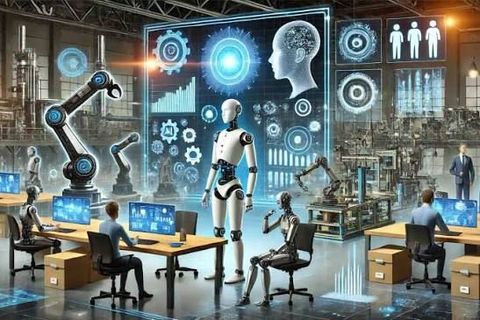
AI in Manufacturing
Industrial AI products can process data from machines, sensors, cameras, and production systems.
Applications include:
- Predictive maintenance
- Quality inspection
- Production monitoring
- Process optimisation
- Demand forecasting
- Machine vision
- Robotics
AI can also be connected to industrial Internet of Things systems for real-time analysis.
AI in Retail
Retail-related AI products can support:
- Demand forecasting
- Inventory analysis
- Recommendation systems
- Customer behaviour analysis
- Visual search
- Product classification
These applications can use large datasets to identify patterns and support operational decisions.
AI in Transportation
Artificial intelligence can be integrated into transportation technologies.
Applications may include:
- Traffic analysis
- Route optimisation
- Driver assistance
- Fleet monitoring
- Predictive maintenance
- Autonomous navigation
Transportation applications require extensive testing because physical environments are complex and unpredictable.
AI in Education
AI products can support education through:
- Personalised learning
- Language assistance
- Automated summarisation
- Learning analytics
- Content generation
- Research support
- Accessibility technologies
Human educators remain important for context, assessment, guidance, and responsible use.
AI in Cybersecurity
AI can help cybersecurity systems process large amounts of information.
Potential applications include:
- Anomaly detection
- Behaviour analysis
- Threat classification
- Fraud detection
- Security monitoring
- Alert prioritisation
AI should complement rather than replace fundamental cybersecurity controls.
AI Agents
AI agents are an emerging category of artificial intelligence products designed to perform multi-step tasks.
A simplified agent workflow can involve:
- Understanding a goal
- Planning actions
- Accessing information
- Using available tools
- Performing tasks
- Evaluating results
Agentic systems introduce additional considerations involving permissions, reliability, monitoring, security, and human oversight.
Multimodal AI
Multimodal AI systems can work with more than one type of information.
They may process:
- Text
- Images
- Audio
- Video
- Documents
- Structured data
This allows AI products to handle more complex interactions than systems limited to a single information format.
Important Features of AI Products
Natural Language Understanding
AI systems can interpret written or spoken language.
Pattern Recognition
Models can identify patterns in large datasets.
Prediction
AI can estimate potential outcomes based on available information.
Content Generation
Generative AI can create new forms of content.
Personalisation
AI can adapt recommendations and outputs according to available information.
Automation
AI can assist with repetitive or data-intensive workflows.
Real-Time Processing
Some AI systems can analyse information and respond with low latency.
Data and AI Products
Data is one of the most important components of an AI system.
Important data considerations include:
- Accuracy
- Relevance
- Volume
- Diversity
- Labelling
- Privacy
- Security
- Governance
Poor-quality data can negatively affect model performance.
Machine Learning in AI Products
Machine learning allows systems to identify patterns from data and improve performance through training.
Common approaches include:
- Supervised learning
- Unsupervised learning
- Self-supervised learning
- Reinforcement learning
Different approaches are appropriate for different types of problems.
Deep Learning
Deep learning uses multi-layer neural networks to process complex patterns.
It is widely associated with:
- Computer vision
- Speech recognition
- Natural language processing
- Generative AI
- Recommendation systems
Deep learning models can require significant computational resources, particularly during training.
AI Inference
Inference occurs when a trained model processes new information.
For example:
New Input → Trained AI Model → Inference → Result
Inference can occur in cloud infrastructure, on local devices, or through a hybrid architecture.
AI Product Security
AI products can introduce specific security considerations.
Potential risks include:
- Unauthorised access
- Data leakage
- Insecure integrations
- Prompt injection
- Model manipulation
- Privacy violations
- Supply-chain vulnerabilities
Security should be considered throughout the AI product lifecycle.
Privacy in AI Products
AI applications may process large amounts of information.
Important privacy considerations include:
- Data minimisation
- Access control
- Encryption
- Retention policies
- User permissions
- Data-processing transparency
- Applicable privacy regulations
Organisations should understand how information is collected, processed, stored, and transmitted.
AI Accuracy and Reliability
Artificial intelligence does not guarantee accurate results.
Errors may occur because of:
- Incomplete information
- Poor-quality training data
- Model limitations
- Ambiguous inputs
- Unexpected situations
- Changing data patterns
High-impact applications require appropriate testing and human review.
AI Bias and Fairness
AI systems can reflect biases contained within their data or development processes.
Potential sources include:
- Unbalanced datasets
- Historical patterns
- Sampling limitations
- Model design
- Evaluation gaps
Responsible AI development includes testing performance across relevant situations and user groups.
AI Explainability
Explainability refers to methods that help people understand how an AI system reaches or supports a particular result.
This can be particularly important for applications involving:
- Healthcare
- Finance
- Safety
- Public-sector decisions
- High-impact business processes
The appropriate level of explainability depends on the risk and purpose of the AI system.
Benefits of Artificial Intelligence Products
AI products can provide several potential benefits.
These include:
- Faster information processing
- Automation
- Pattern recognition
- Decision support
- Personalisation
- Accessibility
- Data analysis
- Operational efficiency
The actual outcome depends on implementation and the quality of the underlying data and workflows.
Limitations of AI Products
AI products also have limitations.
These can include:
- Incorrect outputs
- Bias
- Privacy concerns
- Security risks
- Data dependency
- Integration complexity
- Computational requirements
- Limited contextual understanding
AI should therefore be evaluated according to the specific task rather than treated as universally reliable.
How to Evaluate an AI Product
Define the Purpose
Start by identifying the specific problem the technology is intended to address.
Examine Capabilities
Understand what AI models and functions the product actually provides.
Assess Accuracy
Look for meaningful evaluation methods and performance information.
Review Data Handling
Understand what data the product processes and how it is protected.
Check Integration
Determine whether it can work with existing applications, systems, or hardware.
Consider Scalability
Evaluate whether the technology can support expected workloads.
Review Security
Examine access controls, authentication, monitoring, and data protection.
Consider Human Oversight
Important workflows should have mechanisms for review, correction, and intervention.
Recent Trends in AI Products
Smaller AI Models
Smaller models can make AI more practical for local devices and specialised applications.
Multimodal AI
Systems increasingly combine text, images, audio, video, and documents.
AI Agents
AI products are moving toward systems capable of completing multi-step workflows.
On-Device AI
Dedicated AI hardware is supporting more local processing.
AI Robotics
AI is becoming increasingly integrated with physical machines.
AI Governance
Organisations and governments are paying greater attention to transparency, safety, accountability, privacy, and responsible AI development.
Future of Artificial Intelligence Products
The AI product landscape is likely to become more integrated with everyday computing and physical systems.
Future developments may include:
- More capable AI agents
- Advanced multimodal systems
- Local AI processing
- AI-enabled robotics
- Intelligent industrial equipment
- Personalised digital assistants
- AI-powered scientific tools
- Automated knowledge systems
- Greater human-AI collaboration
The future is likely to involve AI becoming a capability embedded across many different technologies rather than remaining limited to standalone applications.
Frequently Asked Questions
What are artificial intelligence products?
Artificial intelligence products are software, hardware, platforms, or integrated systems that use AI technologies to perform tasks involving prediction, recognition, generation, analysis, language processing, or automation.
What are the main types of AI products?
Major categories include AI assistants, generative AI systems, AI search tools, AI software, AI hardware, AI platforms, robotics, analytics systems, and industry-specific AI technologies.
What is the difference between AI software and AI hardware?
AI software provides computational models and applications, while AI hardware provides the physical computing components used to run AI workloads. Many modern products combine both.
What is an AI agent?
An AI agent is a system designed to pursue a goal by understanding instructions, planning actions, using available tools, and performing multiple steps with varying degrees of autonomy.
Are AI products always accurate?
No. AI products can produce inaccurate, incomplete, or biased results. Their reliability depends on the model, data, application, testing, and operating environment.
Conclusion
Artificial intelligence products now cover a broad range of software, hardware, platforms, and integrated systems. From AI assistants and generative applications to smart devices, robotics, analytics, and industrial technologies, AI is becoming part of many areas of modern technology.
The most important AI technologies include machine learning, deep learning, natural language processing, computer vision, generative AI, edge computing, AI accelerators, and intelligent software architectures.
As these technologies continue to develop, AI products are likely to become more capable, multimodal, connected, and autonomous. At the same time, accuracy, privacy, security, fairness, transparency, and human oversight will remain important considerations.
Understanding AI product categories, technologies, applications, capabilities, and limitations provides a useful foundation for exploring the rapidly developing artificial intelligence ecosystem.
Disclaimer
This article is intended for general educational and informational purposes only. Artificial intelligence technologies, capabilities, specifications, regulations, and product features can change over time. AI-generated information should be independently verified when accuracy is important. Applications involving healthcare, finance, legal matters, safety, personal information, or other high-impact decisions should be evaluated with appropriate professional and regulatory guidance. This content is not intended as brand-specific, promotional, commercial, technical, legal, financial, or professional advice.