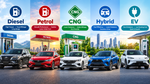
Which Can Be the Best Fuel Type for Cars in 2026: Petrol, Diesel, CNG, Hybrid or EV?
Choosing a new car in 2026 involves more than comparing design, features and performance. The powertrain has become one of the most important decisions because petrol, diesel, CNG, hybrid and electric vehicles offer very different ownership experiences.
India's passenger-vehicle market is also changing rapidly. In August 2026, CNG, hybrid and electric passenger vehicles together accounted for nearly 42% of sales, slightly exceeding petrol-powered cars at about 41%, according to data reported from the Federation of Automobile Dealers Associations.
This does not mean that one fuel type is automatically the right choice for everyone. The best option depends on driving distance, city or highway usage, access to refuelling or charging infrastructure, expected ownership period and personal driving preferences.
Understanding the Main Car Powertrain Options
Before deciding which option is best, it helps to understand how each technology works.
Petrol Cars
Petrol vehicles use an internal-combustion engine designed to run on gasoline. They remain widely available across India and are generally suited to mixed city and highway driving.
Petrol cars can make sense for drivers who want:
- Familiar refuelling infrastructure
- Smooth engine operation
- Relatively simple powertrain choices
- Occasional or moderate driving
- Easy highway travel without planning charging stops
- A broad selection of vehicle models
Petrol is also becoming part of a wider fuel-transition discussion in India because of the nationwide move toward E20 petrol. A flex-fuel passenger vehicle launched in 2026 can operate with ethanol-petrol blends ranging from E20 to E100, showing how fuel technology is evolving beyond conventional petrol.
Diesel Cars
Diesel engines are known for strong low-speed torque and good highway efficiency. They can be particularly useful for drivers who regularly cover long distances.
Diesel can be considered when:
- Annual driving distance is high
- Highway travel is frequent
- Strong pulling ability is important
- The vehicle is frequently driven with passengers or luggage
- Long-distance touring is a major requirement
However, modern diesel vehicles generally have more complex emission-control systems than traditional diesel engines. Urban usage, emissions regulations and future policy developments should therefore be considered before choosing one.
CNG Cars
Compressed natural gas, or CNG, is an established alternative to conventional petrol and diesel powertrains in India.
CNG vehicles are particularly relevant for drivers who spend substantial time on regular urban routes and have dependable access to CNG refuelling stations.
Key characteristics include:
- Generally lower running expense than petrol for comparable usage
- Established CNG infrastructure in many Indian cities
- Lower tailpipe carbon emissions than petrol in many operating conditions
- Usually lower performance than the equivalent petrol configuration in some models
- Additional CNG hardware and a gas cylinder
- Potential reduction in luggage-space flexibility depending on vehicle design
CNG can therefore be a practical middle ground for high-mileage urban users.
Hybrid Cars
A hybrid vehicle combines an internal-combustion engine with an electric motor and battery system. Depending on the technology, the battery may be charged through regenerative braking and engine operation rather than relying exclusively on an external charger.
NITI Aayog's e-AMRIT information distinguishes several electrified vehicle categories, including battery electric vehicles, hybrid electric vehicles and plug-in hybrids.
Hybrids can be attractive for people who want:
- Better efficiency in city traffic
- Reduced fuel consumption
- Smooth electric assistance
- No dependence on regular external charging for conventional hybrids
- Strong suitability for mixed city and highway driving
A hybrid can be particularly interesting for drivers who like the advantages of electrification but regularly undertake journeys where charging infrastructure may be inconvenient.
Electric Vehicles
Battery electric vehicles, or BEVs, use an electric motor powered by a rechargeable battery instead of a conventional combustion engine.
EVs can provide:
- Zero tailpipe emissions
- Quiet operation
- Instant electric-motor response
- High energy efficiency
- Convenient home charging where suitable infrastructure exists
- Reduced dependence on liquid fuels
The Bureau of Energy Efficiency notes that electric mobility can provide zero or ultra-low tailpipe emissions of local air pollutants and lower noise. It also identifies charging infrastructure as an important requirement for wider EV adoption.
Petrol vs Diesel vs CNG vs Hybrid vs EV
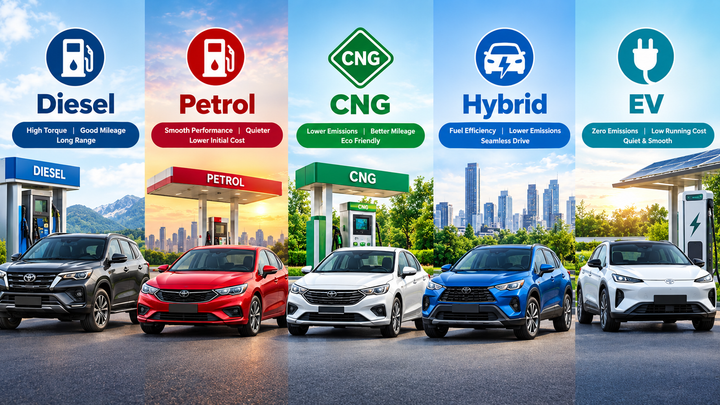
| Factor | Petrol | Diesel | CNG | Hybrid | EV |
|---|---|---|---|---|---|
| City driving | Very good | Good | Excellent | Excellent | Excellent |
| Highway driving | Excellent | Excellent | Good | Excellent | Very good |
| Long-distance use | Excellent | Excellent | Good | Excellent | Depends on charging |
| Refuelling convenience | Excellent | Excellent | Good in supported areas | Excellent | Depends on charging network |
| Tailpipe emissions | Higher | Higher | Generally lower than petrol | Lower than conventional ICE in many conditions | Zero at tailpipe |
| Driving response | Smooth | Strong torque | Smooth to moderate | Smooth | Instant response |
| Charging dependence | No | No | No | Usually no external charging | Yes |
| Best suited to | Mixed usage | High-distance users | Regular urban routes | Mixed usage | Urban and planned long-distance driving |
Which Fuel Type Is Best for City Driving?
For predominantly city-based driving, the answer usually comes down to CNG, hybrid and EV.
EV for Frequent Urban Driving
An EV can be highly suitable for daily city commuting when home or workplace charging is convenient.
Frequent stop-and-go traffic can also suit electric powertrains because regenerative braking can recover some energy during deceleration.
For a driver who travels predictable daily distances and can charge regularly, an EV can be one of the strongest options in 2026.
Hybrid for Mixed Urban Conditions
A hybrid can be a strong alternative for someone who drives extensively in traffic but does not want to depend on external charging.
The electric motor can assist the combustion engine during low-speed operation, while regenerative braking can recover energy during deceleration.
CNG for High-Mileage City Driving
CNG remains relevant for drivers who cover significant distances every day and have convenient access to CNG stations.
It is particularly attractive for predictable urban routes where refuelling can be incorporated into regular travel.
Which Fuel Type Is Best for Highway Driving?
Highway users often place greater importance on driving range, quick refuelling and consistent performance.
Diesel remains relevant for high-distance highway driving because of its torque characteristics and long-distance efficiency.
Petrol is also a strong highway option because of widespread refuelling infrastructure and the availability of many vehicle types.
Hybrid technology can provide an attractive combination of highway performance and improved efficiency.
EVs can also work very well on highways, but the experience depends more heavily on fast-charging availability and route planning.
Which Is Better for High Annual Driving?
For someone covering a high annual distance, fuel efficiency becomes increasingly important.
A general comparison would look like this:
Very high urban mileage: CNG or hybrid
Highway-heavy mileage: Diesel, hybrid or EV depending on charging access
Mixed city and highway: Hybrid
Predictable daily commute: EV or CNG
Occasional driving: Petrol
These are general guidelines rather than universal rules because vehicle efficiency, driving style, traffic conditions and local infrastructure can significantly change the result.
EV vs Hybrid: Which Makes More Sense in 2026?
This is one of the most important comparisons for modern car buyers.
An EV completely replaces the combustion engine with an electric drivetrain. A conventional hybrid keeps an engine but adds electric assistance.
Choose an EV when:
- Daily driving distances are predictable
- Home or workplace charging is available
- Most journeys are within cities
- Quiet and smooth operation is important
- You are comfortable planning longer journeys around charging
Consider a Hybrid when:
- You frequently drive both in cities and on highways
- You do not want regular charging planning
- You want improved urban efficiency
- Long-distance travel is common
- Refuelling convenience is important
India's broader transport transition is moving toward multiple technologies rather than a single immediate replacement. NITI Aayog's 2026 transport scenarios identify zero-emission vehicles, cleaner fuels and technological changes as important parts of India's longer-term mobility transition.
CNG vs Hybrid
CNG and hybrid vehicles approach efficiency differently.
A CNG vehicle changes the fuel used by the combustion engine. A hybrid adds electric assistance to reduce the engine's workload.
CNG may be preferable when:
- Daily mileage is high
- CNG stations are convenient
- Most driving is within a city
- Simple refuelling is preferred
Hybrid may be preferable when:
- Traffic-heavy driving is common
- Highway journeys are frequent
- Better efficiency across different driving conditions is desired
- CNG infrastructure is limited along regular routes
For many mixed-use drivers, hybrid technology can provide greater flexibility. For high-mileage city users with easy CNG access, CNG can remain highly practical.
Petrol vs Hybrid
Petrol cars generally provide a straightforward ownership experience, while hybrids add an electric motor and battery system.
A petrol car may suit someone who:
- Drives relatively fewer kilometres
- Wants conventional technology
- Frequently travels where fuel stations are readily available
- Wants a wide selection of vehicle configurations
A hybrid may make more sense for:
- Frequent city driving
- Higher annual mileage
- Traffic-heavy routes
- Drivers interested in improved efficiency without depending on external charging
The decision should therefore consider actual usage rather than simply comparing the technologies on paper.
Diesel vs Hybrid
Diesel and hybrid technologies can both be attractive for long-distance drivers, but they have different strengths.
Diesel traditionally provides strong torque and efficient highway operation.
Hybrid technology can deliver strong urban efficiency while retaining the flexibility of a combustion engine for longer journeys.
For a driver who spends most of the time on highways, diesel can remain relevant. For mixed city-highway use, a hybrid may provide a broader efficiency advantage.
EV Charging Is a Major Decision Factor
One of the biggest differences between EVs and conventional fuel vehicles is refuelling behaviour.
A petrol, diesel or CNG vehicle can generally be refuelled within minutes when an appropriate station is nearby.
An EV requires charging time, although fast chargers can significantly reduce waiting compared with slower charging methods.
Before selecting an EV, consider:
- Availability of home charging
- Workplace charging
- Public fast chargers along regular routes
- Daily driving distance
- Typical overnight parking duration
- Long-distance travel frequency
- Charging availability at destinations
The BEE identifies adequate charging infrastructure as a key requirement for accelerated EV adoption in India.
What About Maintenance?
Maintenance requirements vary significantly by vehicle design.
Petrol
Petrol cars have conventional engines with established maintenance practices and widespread technical familiarity.
Diesel
Diesel vehicles can have additional emissions-control components and may be more appropriate for users who regularly drive longer distances.
CNG
CNG vehicles have both conventional engine components and dedicated gas-system components that require appropriate inspection.
Hybrid
Hybrid vehicles combine combustion and electric systems. Their powertrains are more complex, but regenerative braking can reduce conventional brake wear in certain driving conditions.
EV
EVs have fewer moving drivetrain components than combustion-engine vehicles. There is no conventional engine oil system, while battery, motor, electronics, tyres, brakes and thermal-management components remain important areas of vehicle upkeep.
Which Fuel Type Is More Environmentally Friendly?
From a tailpipe-emissions perspective, EVs have a major advantage because they produce no tailpipe emissions during driving.
However, a complete environmental assessment involves more than tailpipe emissions. Electricity generation, battery manufacturing, vehicle production and recycling also matter.
Hybrids can reduce fuel consumption compared with conventional combustion vehicles, while CNG can reduce certain emissions compared with petrol and diesel.
India's transport sector remains closely connected with energy consumption and emissions. BEE estimates that transport accounts for about 18% of India's total energy consumption and that road transport contributes a substantial share of transport-related CO₂ emissions.
What Is Happening in India's Car Market in 2026?
The Indian market is increasingly becoming powertrain-diverse.
August 2026 marked an important shift: CNG, hybrid and electric passenger vehicles collectively overtook petrol in monthly passenger-vehicle sales, reaching nearly 42% compared with about 41% for petrol, according to FADA data reported by Reuters.
This does not indicate that petrol or diesel vehicles are disappearing immediately. Instead, it shows that buyers now have more practical alternatives than they did several years ago.
Manufacturers are responding with a broader mix of petrol, CNG, hybrid and electric models. Some are also developing flex-fuel technologies as India expands its ethanol ecosystem.
How Government Policies Are Influencing the Choice
India's vehicle-efficiency framework is also encouraging improvements across different powertrain technologies.
The Bureau of Energy Efficiency states that Corporate Average Fuel Efficiency, or CAFE, norms apply to petrol, diesel, LPG, CNG, hybrid and electric passenger vehicles with gross vehicle weight below 3,500 kg. The framework is intended to reduce fuel consumption and CO₂ emissions.
This means the transition is not simply about replacing every petrol or diesel vehicle with an EV overnight. Improvements in efficiency, electrification, alternative fuels and cleaner technologies are all part of the broader transition.
Does Location Matter?
Yes.
The best fuel type can change considerably depending on where the vehicle is driven.
A person in a city with strong CNG availability may find CNG extremely convenient.
Someone with home charging and mostly urban travel may find an EV more suitable.
A frequent intercity traveller may prefer a hybrid, petrol or diesel vehicle because of greater flexibility on long routes.
Policy can also differ by region. For example, Delhi-NCR has introduced increasingly stringent measures affecting certain conventional vehicle categories, while policymakers have indicated that similar restrictions may expand in the future.
Therefore, buyers should check the latest local registration and usage regulations before making a long-term decision.
A Simple Decision Guide
Choose Petrol If:
- Your annual driving is moderate
- You frequently travel long distances
- You want widespread refuelling infrastructure
- You prefer conventional vehicle technology
- Your daily driving pattern is unpredictable
Choose Diesel If:
- You drive long distances frequently
- Highway usage is high
- Strong torque is important
- You regularly travel with heavy loads or passengers
- The vehicle fits your long-term usage pattern
Choose CNG If:
- You drive extensively in cities
- CNG stations are convenient on your routes
- Daily mileage is high
- Lower running expense is an important consideration
- Your regular routes are predictable
Choose Hybrid If:
- You drive in both cities and on highways
- Traffic is common
- You want improved efficiency without depending on external charging
- Long-distance flexibility is important
- You want a transition toward electrification without moving completely to an EV
Choose EV If:
- Most journeys are urban
- Daily driving is predictable
- Home or workplace charging is available
- You want zero tailpipe emissions
- You are comfortable planning longer journeys around charging
Which Fuel Type Can Be the Best Overall Choice in 2026?
There is no single winner for every driver.
Petrol remains a flexible choice for moderate and mixed usage.
Diesel can still make sense for high-distance highway users.
CNG is highly relevant for high-mileage urban driving where refuelling infrastructure is convenient.
Hybrid is one of the most versatile choices for drivers who want better efficiency across city and highway conditions without depending on external charging.
EV can be one of the strongest choices for predictable urban driving when convenient charging is available.
For many Indian drivers in 2026, hybrid and EV technology represent the strongest long-term efficiency direction, while CNG remains highly practical for intensive urban use and petrol remains a flexible conventional option.
The right decision should ultimately be based on your driving pattern rather than the technology's popularity.
Frequently Asked Questions
1. Which is the best fuel type for cars in 2026?
There is no universal best option. EVs can be excellent for predictable urban driving with convenient charging, hybrids suit mixed driving, CNG can work well for high-mileage city use, diesel remains relevant for extensive highway travel, and petrol offers broad flexibility.
2. Is EV better than hybrid in 2026?
An EV can be preferable when charging is convenient and most journeys are predictable. A hybrid can be more suitable for drivers who frequently travel long distances or do not want to depend on external charging.
3. Is CNG still a good option in 2026?
Yes. CNG remains relevant for high-mileage urban users, particularly where CNG stations are readily accessible along regular routes.
4. Are diesel cars still relevant in 2026?
Yes, particularly for users who regularly cover long highway distances. However, emissions regulations and regional restrictions should be considered before choosing a diesel vehicle.
5. Should occasional drivers choose an EV?
It depends on charging access and usage patterns. An EV can work well for occasional driving if the vehicle can be conveniently charged during parking periods. For irregular long-distance travel, petrol or hybrid technology may provide greater flexibility.
6. Which powertrain is best for long-distance travel?
Diesel, petrol and hybrid vehicles can provide strong long-distance flexibility because refuelling is generally quick and widespread. EVs can also be effective when the route has dependable fast-charging infrastructure.
Conclusion
The question of the best fuel type for cars in 2026 has become more complicated because Indian consumers now have more powertrain choices than ever.
Petrol remains versatile, diesel continues to serve high-distance users, CNG is practical for intensive city driving, hybrids provide a balance between combustion and electrification, and EVs represent a major step toward zero-tailpipe-emission mobility.
The strongest choice is therefore not necessarily the newest technology. It is the powertrain that matches your daily distance, city-highway ratio, charging or refuelling access, travel habits, local regulations and expected ownership period.
As India's automotive market continues moving toward greater electrification and fuel diversity, understanding these differences can help drivers make a more informed decision in 2026.
Disclaimer
This article is intended for general educational and informational purposes only. Fuel efficiency, emissions, vehicle technology, regulations, infrastructure and manufacturer specifications can change over time and may vary by vehicle and location. The article is not intended as brand promotion, sales material or a specific vehicle recommendation. Readers should verify current specifications, applicable regulations and infrastructure availability through authoritative sources before making a vehicle-related decision.