Diesel vs Petrol vs CNG vs Hybrid vs EV Explained: Key Differences
Choosing a vehicle powertrain has become more complicated than simply deciding between petrol and diesel. Modern buyers can now consider petrol, diesel, CNG, hybrid and electric vehicles (EVs), with each technology designed around different operating principles.
Petrol and diesel vehicles use internal-combustion engines, while CNG vehicles also use an internal-combustion engine but operate on compressed natural gas. Hybrid vehicles combine an internal-combustion engine with electric propulsion, while battery electric vehicles use electricity stored in a battery to power an electric motor. NITI Aayog and the Government of India distinguish battery-electric, hybrid and plug-in-hybrid architectures based on how energy is stored and supplied to the drivetrain.
The differences extend beyond the type of fuel. Engine characteristics, energy efficiency, emissions, driving patterns, refuelling or charging infrastructure, maintenance requirements, vehicle packaging and long-distance practicality can all influence the suitability of a particular powertrain.
This guide explains Diesel vs Petrol vs CNG vs Hybrid vs EV, how each technology works, their major advantages and limitations, and which type of powertrain may be better suited to different driving conditions.
What Are Petrol, Diesel, CNG, Hybrid and EV Vehicles?
Before comparing them, it is useful to understand the basic technology behind each option.
Petrol Vehicles
Petrol vehicles use a spark-ignition internal-combustion engine.
The engine burns petrol and converts the resulting energy into mechanical power that ultimately drives the wheels.
Petrol engines are commonly associated with:
- Smooth engine operation
- Easy cold starting
- Responsive acceleration
- Wide availability of fuel stations
- Strong suitability for urban and mixed driving
Modern petrol engines can use technologies such as turbocharging, direct injection, variable valve timing and cylinder-management systems to improve efficiency and performance.
Diesel Vehicles
Diesel vehicles use compression ignition.
Instead of relying on a conventional spark plug to ignite the fuel-air mixture, a diesel engine compresses air to a high temperature and then injects diesel fuel.
Diesel engines are generally known for:
- Strong low-speed torque
- Efficient highway operation
- Suitability for heavy loads
- Long-distance driving capability
- Strong pulling characteristics
Modern diesel vehicles use sophisticated emissions-control systems to comply with increasingly strict emission standards.
CNG Vehicles
CNG stands for Compressed Natural Gas.
A CNG vehicle typically uses an internal-combustion engine adapted to run on compressed natural gas, with fuel stored in high-pressure cylinders.
CNG vehicles can offer:
- Lower tailpipe emissions for some pollutants compared with conventional fuels
- Smooth operation
- A familiar internal-combustion driving experience
- Potential suitability for high-mileage urban use
However, CNG availability varies by region, and the fuel tank arrangement can influence luggage space and vehicle packaging.
Hybrid Vehicles
Hybrid vehicles combine an internal-combustion engine with an electric motor and battery system.
A hybrid can use the engine, electric motor, or both depending on the vehicle design and driving conditions.
NITI Aayog describes hybrid electric vehicles as combining an internal-combustion engine with a battery-powered electric motor, with the battery charged through the engine and regenerative braking.
There are several hybrid architectures, including:
- Mild hybrid
- Strong or full hybrid
- Plug-in hybrid
These technologies should not be treated as identical because their electric-driving capability and charging methods differ.
Electric Vehicles
Battery electric vehicles, or BEVs, use a rechargeable battery and electric motor instead of an internal-combustion engine.
Electricity is stored in the battery and supplied to the motor through power electronics.
A BEV generally includes:
- Battery pack
- Electric motor
- Inverter or power electronics
- Charging system
- Thermal-management system
- Vehicle control systems
Unlike petrol, diesel and CNG vehicles, a battery electric vehicle does not have a combustion engine producing tailpipe emissions. NITI Aayog notes that BEVs have no tailpipe emissions during operation.
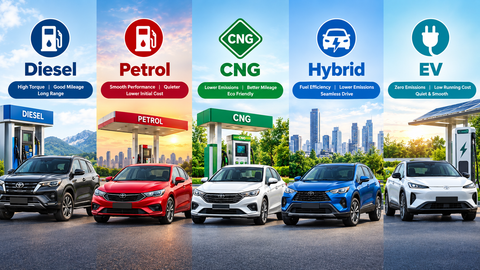
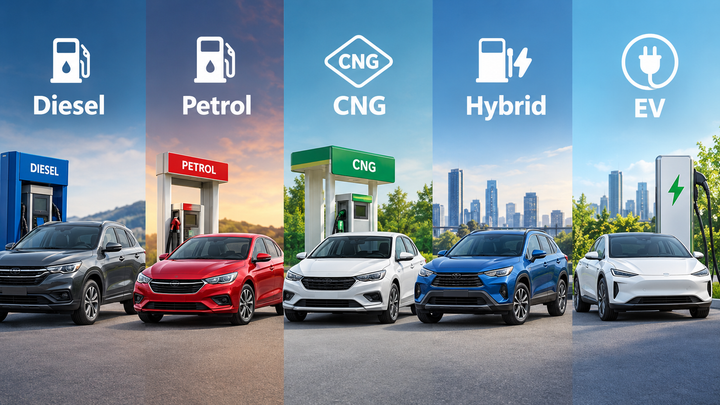
Diesel vs Petrol vs CNG vs Hybrid vs EV: Quick Comparison
| Feature | Petrol | Diesel | CNG | Hybrid | EV |
|---|---|---|---|---|---|
| Main energy source | Petrol | Diesel | Compressed natural gas | Fuel + electricity | Electricity |
| Main propulsion | ICE | ICE | ICE | ICE + electric motor | Electric motor |
| Combustion engine | Yes | Yes | Yes | Yes | No |
| External charging | No | No | No | Usually no for HEV | Yes |
| Regenerative braking | Generally no | Generally no | Generally no | Yes | Yes |
| Tailpipe emissions | Yes | Yes | Yes | Yes | No |
| Engine noise | Moderate | Usually higher | Moderate | Often lower in electric operation | Very low |
| Long-distance refuelling | Widely available | Widely available | Region dependent | Fuel-based | Charging dependent |
| Urban efficiency | Good | Good | Good | Very good in many conditions | Very good |
| Highway suitability | Very good | Very good | Good where infrastructure exists | Very good | Very good with charging planning |
| Driving character | Smooth and responsive | Strong torque | Smooth | Smooth and efficient | Instant torque |
The table provides a general technology comparison. Actual efficiency, emissions, performance and operating characteristics vary considerably between individual vehicles.
How Petrol Engines Work
A petrol engine generally follows four primary stages:
- Intake
- Compression
- Combustion
- Exhaust
Air and petrol enter the combustion chamber, the mixture is compressed, and ignition occurs through a spark.
The resulting combustion pushes the piston and rotates the crankshaft.
Modern petrol engines can use turbochargers to increase the amount of air entering the engine. This can allow smaller engines to produce more power while maintaining relatively compact dimensions.
Advantages of Petrol Technology
Petrol vehicles can be attractive because they typically provide:
- Smooth acceleration
- Lower engine noise than many diesel engines
- Strong suitability for city driving
- Easy availability of fuel
- Wide selection of vehicles
- Familiar maintenance infrastructure
Limitations of Petrol Technology
Potential limitations include:
- Higher fuel consumption than some diesel or hybrid vehicles in certain conditions
- Tailpipe emissions
- Continued dependence on liquid fuel
- Lower low-speed torque than many diesel engines of similar capacity
How Diesel Engines Work
Diesel engines use compression ignition.
The engine compresses air to a high pressure and temperature before diesel fuel is injected.
The fuel ignites because of the temperature generated by compression.
Diesel engines are often designed to produce strong torque at relatively low engine speeds.
Advantages of Diesel Technology
Diesel can be particularly suited to:
- Long-distance driving
- Highway use
- Heavy loads
- High annual mileage
- Larger vehicles
- Frequent intercity travel
Limitations of Diesel Technology
Diesel vehicles can have:
- More complex emissions-control equipment
- Higher noise and vibration in some applications
- Potentially greater sensitivity to short-trip operating patterns
- More complex exhaust-treatment systems in modern vehicles
Modern diesel vehicles must meet applicable emissions requirements, which can involve technologies such as diesel particulate filters and selective catalytic reduction systems.
How CNG Vehicles Work
CNG is stored under high pressure and supplied to an engine through a fuel system designed for gaseous fuel.
The engine then uses combustion to generate mechanical power.
Many CNG passenger vehicles are designed as dual-fuel systems that can operate on both petrol and CNG.
Advantages of CNG
CNG can provide:
- An alternative to conventional petrol operation
- Potentially lower emissions of certain pollutants
- Quiet combustion characteristics
- Useful efficiency for high-mileage driving
- Dual-fuel flexibility in many vehicles
The Bureau of Energy Efficiency notes that CNG vehicles are included alongside petrol, diesel, hybrid and electric passenger vehicles within India's corporate average fuel-efficiency framework.
Limitations of CNG
CNG has several practical considerations:
- Refuelling infrastructure is not equally available everywhere
- High-pressure tanks require dedicated packaging
- Luggage space can be affected in some vehicle designs
- Long-distance travel requires route planning where CNG stations are limited
- Performance can differ from petrol operation depending on engine design
How Hybrid Vehicles Work
Hybrid vehicles combine two propulsion systems.
The first is generally an internal-combustion engine.
The second is an electric motor powered by a battery.
The system can automatically determine when to use:
- Electric propulsion
- Engine propulsion
- Combined propulsion
- Regenerative braking
Regenerative Braking
Regenerative braking is one of the key technologies behind hybrid vehicles.
During deceleration, the electric motor can operate as a generator and convert part of the vehicle's kinetic energy into electrical energy.
The electricity is then stored in the battery.
This is different from conventional braking, where much of the vehicle's kinetic energy is converted into heat through the braking system.
Government sources describe regenerative braking as a method used by hybrid and electric vehicles to recover energy that would otherwise be lost during braking.
Types of Hybrid Vehicles
Mild Hybrid
A mild hybrid uses a relatively small electric system to support the combustion engine.
It may assist during:
- Starting
- Acceleration
- Stop-start operation
A mild hybrid generally cannot provide extensive electric-only driving.
Full Hybrid
A full hybrid has a larger electric propulsion capability and can sometimes operate using electric power alone for short periods.
The system automatically combines engine and electric operation according to driving conditions.
Plug-In Hybrid
A plug-in hybrid, or PHEV, combines an internal-combustion engine and electric powertrain but also has a battery that can be charged externally.
NITI Aayog explains that PHEVs can operate in electric and hybrid modes and can charge through an external electricity source as well as through engine operation and regenerative braking.
How Electric Vehicles Work
An EV replaces the conventional combustion engine with an electric propulsion system.
The basic energy path is:
Electricity → Battery → Power Electronics → Electric Motor → Wheels
When the vehicle is connected to a charger, electrical energy is stored in the battery.
When driving, the battery supplies electricity to the motor.
The motor converts electrical energy into mechanical rotation.
Regenerative Braking in EVs
Electric vehicles can also recover energy during deceleration.
When the accelerator is released or the brake is applied under suitable conditions, the motor can act as a generator.
Some of the vehicle's kinetic energy is converted into electrical energy and returned to the battery.
Diesel vs Petrol
Diesel and petrol remain fundamentally different internal-combustion technologies.
Performance
Diesel engines generally provide stronger low-speed torque, while petrol engines can provide smoother high-revving characteristics.
Driving Pattern
Diesel can make more sense for drivers who frequently travel long distances.
Petrol can be more convenient for drivers who mainly use their vehicle for short urban trips.
Refinement
Modern petrol engines are generally perceived as smoother and quieter, although diesel technology has improved considerably.
Emissions
Both produce tailpipe emissions.
The exact emission profile depends on the engine, emissions-control system, fuel, vehicle condition and driving conditions.
Petrol vs CNG
Both petrol and CNG vehicles generally use internal-combustion engines.
The primary difference is the fuel.
Petrol
- Greater fuel-station availability
- Strong performance characteristics
- No separate CNG tank
- Familiar refuelling infrastructure
CNG
- Alternative gaseous fuel
- Potential emissions advantages for some pollutants
- Requires CNG refuelling infrastructure
- Can affect packaging
- Often attractive for high annual urban mileage
Petrol vs Hybrid
The main difference is that a hybrid adds an electric propulsion system to the combustion engine.
Petrol
A conventional petrol vehicle relies on its combustion engine for propulsion.
Hybrid
A hybrid can combine engine and electric motor operation.
This allows energy recovery during braking and can reduce engine operation under some driving conditions.
Hybrids can therefore be particularly effective in stop-and-go urban traffic, where frequent braking and acceleration provide opportunities for energy recovery.
Hybrid vs EV
Hybrid and electric vehicles both use electric motors, but their energy systems are fundamentally different.
Hybrid
A conventional hybrid continues to use liquid fuel.
Its battery is primarily charged through regenerative braking and engine operation.
EV
A battery electric vehicle depends entirely on stored electrical energy for propulsion.
The battery is charged externally.
NITI Aayog identifies BEVs as vehicles powered entirely by a battery and electric drivetrain, while HEVs combine conventional fuel with electric propulsion.
CNG vs EV
CNG and EV represent two very different approaches.
CNG remains a combustion technology, while an EV uses electric propulsion.
CNG
- Requires gaseous-fuel refuelling
- Produces tailpipe emissions
- Familiar combustion-engine driving
- Suitable where CNG infrastructure is strong
EV
- Requires charging
- Has no tailpipe emissions
- Very quiet operation
- High drivetrain efficiency
- Requires charging planning for longer journeys
BEE states that battery-operated vehicles have zero tailpipe and noise emissions, while conventional petrol, diesel and CNG vehicles contribute to particulate emissions.
Diesel vs Hybrid
Diesel and hybrid vehicles can both be efficient, but their strengths differ.
Diesel technology can be advantageous for:
- Long highway journeys
- Heavy loads
- High-speed intercity driving
- Frequent long-distance travel
Hybrid technology can be advantageous for:
- Urban traffic
- Stop-start driving
- Frequent acceleration and deceleration
- Drivers who want electric assistance without relying entirely on charging infrastructure
The appropriate choice depends strongly on the driving cycle.
Diesel vs EV
The biggest distinction is the propulsion system.
Diesel uses a combustion engine, while an EV uses an electric motor.
Diesel
- Fast refuelling
- Strong long-distance practicality
- Extensive fuel infrastructure
- Tailpipe emissions
- Engine and exhaust-system maintenance
EV
- External charging
- No tailpipe emissions
- High drivetrain efficiency
- Quiet operation
- Battery and charging considerations
For drivers with convenient home or workplace charging, EV ownership can be particularly practical.
For drivers frequently travelling long distances through areas with limited charging infrastructure, a conventional fuel vehicle may still offer greater refuelling flexibility.
Energy Efficiency
Energy efficiency is one of the biggest differences between these technologies.
An electric motor converts electrical energy into motion much more directly than a combustion engine converts fuel energy into mechanical work.
However, vehicle efficiency should not be judged solely by the motor.
The overall system also depends on:
- Vehicle weight
- Aerodynamics
- Tyre resistance
- Driving conditions
- Climate-control usage
- Battery efficiency
- Engine efficiency
- Transmission
- Traffic conditions
BEE's corporate fuel-efficiency framework covers petrol, diesel, LPG, CNG, hybrid and electric passenger vehicles, reflecting the importance of comparing energy consumption across different powertrain technologies.
Emissions Comparison
A common misconception is that one powertrain is automatically cleaner under every circumstance.
The answer depends on what type of emissions are being considered.
Petrol
Produces tailpipe emissions including carbon dioxide and other combustion-related pollutants.
Diesel
Produces carbon dioxide and other pollutants but modern vehicles use emissions-control systems to reduce regulated pollutants.
CNG
Can produce lower levels of some pollutants than conventional fuels in certain applications, but it remains a combustion technology and produces tailpipe emissions.
Hybrid
Uses a combustion engine and therefore produces tailpipe emissions, but electric assistance can reduce engine operation and improve efficiency under suitable conditions.
EV
Produces no tailpipe emissions during operation.
However, electricity generation and battery manufacturing have environmental impacts, so a complete lifecycle assessment is broader than tailpipe emissions alone.
City Driving vs Highway Driving
The best powertrain can change according to the driving environment.
Mostly City Driving
Potentially suitable options include:
- Petrol
- CNG
- Hybrid
- EV
Hybrid and EV technologies can be particularly effective in stop-start traffic because electric motors can operate efficiently at low speeds and hybrids/EVs can recover energy during braking.
Mostly Highway Driving
Potentially suitable options include:
- Petrol
- Diesel
- Hybrid
- EV
Diesel can remain attractive for frequent long-distance travel, while EVs can work very well when charging infrastructure is available along the route.
Mixed City and Highway Driving
The choice becomes more dependent on annual distance and charging or refuelling access.
A hybrid can provide a middle-ground approach, while a petrol vehicle offers broad flexibility.
Maintenance Differences
Maintenance requirements vary by powertrain.
Petrol
Typical maintenance can involve:
- Engine oil
- Oil filter
- Air filter
- Spark plugs
- Cooling system
- Transmission
- Braking system
Diesel
In addition to conventional engine components, modern diesel vehicles can include more complex emissions-control systems.
Potential components include:
- Diesel particulate filter
- Exhaust gas recirculation system
- Selective catalytic reduction
- Diesel exhaust fluid system on applicable models
CNG
CNG vehicles share many components with petrol vehicles but also require attention to:
- CNG fuel system
- High-pressure components
- Gas lines
- Fuel injectors
- Tank-related inspection requirements
Hybrid
Hybrids combine conventional engine maintenance with electric-system components.
Depending on the design, maintenance can involve:
- Engine components
- Hybrid battery
- Electric motor system
- Inverter
- Cooling systems
- Regenerative braking system
EV
EVs generally have fewer moving drivetrain components than combustion vehicles.
There is no conventional:
- Engine oil
- Spark plug
- Exhaust system
- Multi-speed combustion-engine gearbox in many designs
However, EVs still require maintenance for:
- Tyres
- Brakes
- Suspension
- Cooling systems
- Electrical components
- Battery systems
- Cabin filters
Refuelling vs Charging
One of the most important practical differences is how energy is replenished.
Petrol
Refuelling is generally quick and widely available.
Diesel
Also benefits from extensive fuel infrastructure and quick refuelling.
CNG
Refuelling can be convenient where stations are readily available, but infrastructure is less uniform than petrol and diesel.
Hybrid
A conventional hybrid generally does not need external charging.
EV
An EV requires access to charging infrastructure.
Charging can take place through:
- Home charging
- Workplace charging
- Public AC charging
- Public DC fast charging
BEE notes that charging time varies significantly depending on battery capacity, charger power and charging conditions.
EV Charging and Daily Usage
For EV owners, charging availability becomes part of the daily routine.
A driver with home charging may simply connect the vehicle when parked overnight.
A driver without convenient home charging may depend more heavily on:
- Workplace charging
- Public charging stations
- Destination charging
- Fast-charging networks
Therefore, the practicality of an EV depends not only on the vehicle but also on the charging environment.
Battery Technology in EVs
The battery is one of the most important components of an EV.
Modern electric vehicles use lithium-ion battery technologies with different chemistries.
Battery performance depends on:
- Cell chemistry
- Battery capacity
- Thermal management
- Charging patterns
- Ambient temperature
- Driving conditions
- Battery-management system
Battery Capacity
Battery capacity is usually measured in kilowatt-hours, or kWh.
A larger battery can generally provide greater driving range, although it also adds weight.
Battery Management System
The battery-management system monitors battery conditions and helps control:
- Voltage
- Temperature
- Charging
- Discharging
- Cell balancing
- Safety parameters
Vehicle Weight
Powertrain technology also affects vehicle weight.
EVs can carry substantial battery packs, while hybrids carry both combustion and electric systems.
CNG vehicles require high-pressure fuel cylinders.
Diesel and petrol vehicles carry engines, fuel tanks and associated components.
Vehicle weight affects:
- Acceleration
- Braking
- Energy consumption
- Tyre wear
- Handling
This is why powertrain comparison should not be based solely on the energy source.
Driving Experience
Petrol
Usually provides smooth and predictable acceleration.
Diesel
Often provides strong low-speed pulling power.
CNG
Generally provides a familiar combustion-engine driving experience.
Hybrid
Can provide smooth low-speed electric assistance and seamless transitions between power sources.
EV
Provides instant electric-motor torque, quiet operation and smooth acceleration.
The actual experience depends on vehicle design, motor output, transmission, software calibration and suspension tuning.
Which Powertrain Is Better for High-Mileage Drivers?
Drivers covering high annual distances should evaluate:
- Driving environment
- Fuel or electricity availability
- Vehicle efficiency
- Refuelling time
- Charging access
- Maintenance requirements
A diesel can be useful for frequent highway travel.
A hybrid can be useful for high urban mileage.
A CNG vehicle can be relevant where CNG infrastructure is convenient.
An EV can be highly practical for high daily mileage when reliable charging is available.
There is no universal answer because the most appropriate technology depends on the actual usage pattern.
Which Powertrain Is Better for City Driving?
City driving often involves:
- Frequent braking
- Low average speed
- Stop-and-go traffic
- Short trips
- Frequent acceleration
These conditions can benefit hybrid and electric propulsion.
EVs can use regenerative braking to recover some energy during deceleration.
Hybrids can also recover braking energy while allowing the combustion engine to operate when needed.
Petrol and CNG remain practical alternatives, particularly where charging or CNG infrastructure is limited.
Long-Distance Travel Considerations
Long-distance drivers should focus on infrastructure as much as powertrain specifications.
Important questions include:
- How frequently will the vehicle be driven on highways?
- Are charging stations available on common routes?
- How long are typical stops?
- Is fast charging available?
- Are CNG stations available along the route?
- Is luggage capacity important?
- Is towing or heavy loading involved?
For some drivers, rapid liquid-fuel refuelling may remain a major advantage.
For others, EV charging may be sufficiently convenient that charging time is no longer a significant limitation.
Role of Government Policies in Vehicle Powertrains
Vehicle powertrain choices are also influenced by government regulations and efficiency standards.
India's Corporate Average Fuel Economy framework applies to petrol, diesel, LPG, CNG, hybrid and electric passenger vehicles below the specified gross vehicle weight threshold. The framework is designed to reduce fuel consumption and associated CO₂ emissions.
In July 2026, the Ministry of Power circulated draft CAFE-III norms for stakeholder consultation. The proposed norms are intended to apply to M1 passenger vehicles manufactured or imported for sale in India from 2027-28 through 2031-32.
These developments indicate that vehicle efficiency and emissions will remain important factors in India's automotive technology landscape.
Diesel, CNG and EV Policies in Delhi-NCR
Vehicle policies can also vary by region.
Delhi-NCR has introduced measures aimed at reducing emissions from older and higher-polluting vehicles.
For example, the PARIVARTAN scheme approved in 2026 focuses on replacing older BS-IV or earlier commercial trucks and buses in specified NCR areas with BS-VI or stricter-compliant or electric vehicles.
This illustrates why vehicle regulations should always be checked according to the vehicle type, registration location and intended operating area.
Hybrid vs EV: Which Technology Is More Flexible?
A conventional hybrid generally provides greater refuelling flexibility because it can operate using liquid fuel without depending on external charging.
An EV has a simpler propulsion architecture but depends on access to electrical charging.
Therefore:
Hybrid = fuel flexibility + electric assistance
EV = fully electric propulsion + charging dependence
For drivers who have reliable home charging, the EV model can be very convenient.
For drivers who regularly travel unpredictable long-distance routes, a hybrid may provide additional flexibility.
CNG vs Hybrid: Which Is Different?
CNG and hybrid technologies address efficiency in different ways.
CNG changes the fuel used by the combustion engine.
Hybrid technology combines combustion and electric propulsion.
A CNG vehicle does not automatically become an electric vehicle simply because it may have electronic controls or a small battery.
A hybrid has an actual electric propulsion system integrated into the drivetrain.
Petrol vs Hybrid: Key Difference
The simplest distinction is:
Petrol vehicle: combustion engine is the primary propulsion system.
Hybrid vehicle: combustion engine and electric motor work together.
A hybrid can recover braking energy and use electric propulsion in suitable conditions.
This can be especially useful in urban traffic.
Diesel vs CNG: Key Difference
Both use combustion engines, but they operate on different fuels.
Diesel engines use compression ignition.
CNG engines generally use spark ignition and gaseous fuel.
Diesel tends to offer strong torque and long-distance capability.
CNG can be attractive for drivers with convenient access to CNG refuelling infrastructure.
Diesel vs Petrol vs CNG vs Hybrid vs EV: Technology Summary
| Technology | Main Strength | Main Consideration |
|---|---|---|
| Petrol | Versatile everyday driving | Tailpipe emissions and fuel consumption |
| Diesel | Long-distance torque and efficiency | More complex emissions systems |
| CNG | Alternative gaseous fuel | Refuelling infrastructure |
| Hybrid | Efficient mixed propulsion | More complex powertrain |
| EV | Efficient electric propulsion | Charging infrastructure and planning |
Common Misconceptions
“EVs Produce No Environmental Impact”
An EV has no tailpipe emissions during operation, but its overall environmental footprint also includes battery manufacturing, electricity generation, material extraction and end-of-life processes.
“Hybrid Means Electric Vehicle”
A conventional hybrid still uses a combustion engine and liquid fuel.
“CNG Has Zero Emissions”
CNG vehicles still burn fuel and produce tailpipe emissions.
“Diesel Is Always More Efficient”
Diesel can be highly efficient in suitable driving conditions, but efficiency depends on the specific vehicle, engine, traffic conditions and driving pattern.
“The Biggest Battery Is Always Better”
A larger battery can increase range but also adds weight, material requirements and vehicle mass.
How to Choose Between Diesel, Petrol, CNG, Hybrid and EV
Instead of asking which technology is universally best, evaluate your actual driving pattern.
Choose Petrol When
Petrol may be suitable when:
- Annual mileage is moderate
- Driving is mixed
- Fuel infrastructure is important
- Simplicity and flexibility are priorities
- Regular long-distance travel is not the main requirement
Consider Diesel When
Diesel may be relevant when:
- Annual mileage is high
- Highway driving is frequent
- Strong low-speed torque is useful
- Long-distance travel is common
- Refuelling speed matters
Consider CNG When
CNG may be relevant when:
- CNG stations are easily accessible
- Daily mileage is high
- Urban driving dominates
- Alternative fuel operation is preferred
- The available vehicle meets luggage and performance requirements
Consider Hybrid When
A hybrid may be suitable when:
- City driving is frequent
- Stop-start traffic is common
- You want electric assistance without depending entirely on charging
- Long-distance flexibility is important
- Efficiency is a major priority
Consider EV When
An EV may be suitable when:
- Home or workplace charging is available
- Daily travel is predictable
- Low-noise driving is preferred
- Electric operation is a priority
- Public charging is adequate for longer journeys
Future of Vehicle Powertrains
The automotive industry is moving toward a more diverse powertrain landscape rather than relying on one technology alone.
Electric vehicles are expanding, while hybrids, CNG, improved petrol engines, efficient diesel systems and alternative fuels continue to play roles in different applications.
India's policy direction also reflects a broader focus on energy efficiency, emissions reduction and reduced dependence on imported petroleum. BEE identifies transport energy use and petroleum dependence as important factors behind India's efficiency and e-mobility initiatives.
Emerging technologies include:
- Battery electric vehicles
- Plug-in hybrids
- Strong hybrids
- Hydrogen fuel-cell vehicles
- Flex-fuel vehicles
- Alternative low-carbon fuels
- Advanced battery systems
- More efficient combustion engines
In 2026, India has also expanded work around flex-fuel vehicles and E85 fuel. Government information states that E85 is intended for specially designed flex-fuel vehicles rather than conventional petrol vehicles.
This suggests that the future automotive landscape is likely to contain multiple propulsion technologies rather than a single universal solution.
FAQs
Which is better: petrol or diesel?
It depends on usage. Petrol can be suitable for mixed and moderate-distance driving, while diesel can be advantageous for frequent highway travel, high annual mileage and situations where strong torque is useful.
Is CNG better than petrol?
CNG can be attractive for drivers with convenient access to CNG refuelling and substantial annual mileage. Petrol generally provides broader refuelling flexibility.
Is a hybrid better than an EV?
Neither is universally better. A hybrid can provide fuel-based flexibility with electric assistance, while an EV provides fully electric propulsion and can be particularly convenient when reliable charging is available.
Are EVs completely emission-free?
EVs have no tailpipe emissions during operation. However, their overall environmental impact includes electricity generation, battery production, raw-material extraction and other lifecycle factors.
Which vehicle type is best for city driving?
Hybrid and EV powertrains can be particularly well suited to stop-start urban traffic because electric propulsion and regenerative braking can improve energy efficiency. Petrol and CNG can also be practical where charging or CNG infrastructure is limited.
Which powertrain is best for long-distance travel?
Diesel, petrol, hybrid and EVs can all support long-distance travel. The most important factors are fuel or charging infrastructure, driving range, travel patterns and refuelling or charging time.
Do hybrid vehicles need to be charged?
A conventional hybrid generally does not require external charging. Its battery is charged through the engine and regenerative braking. A plug-in hybrid can also be charged externally.
Conclusion
The comparison between Diesel vs Petrol vs CNG vs Hybrid vs EV does not have one universal winner.
Each powertrain solves a different transportation problem.
Petrol provides broad flexibility and familiar everyday operation.
Diesel remains relevant for long-distance driving, high annual mileage and strong torque requirements.
CNG provides an alternative combustion-fuel pathway that can be useful where refuelling infrastructure is convenient.
Hybrid combines an internal-combustion engine with electric propulsion and can be particularly effective in stop-start driving.
EV provides fully electric propulsion, no tailpipe emissions and a highly efficient drivetrain, but requires appropriate charging access.
The most suitable choice should therefore be based on daily distance, city-versus-highway usage, charging or refuelling access, passenger and luggage requirements, climate, driving habits, vehicle availability and local regulations.
As vehicle technology continues to evolve, buyers are likely to see an increasingly diverse range of powertrain options. Understanding how each technology works makes it easier to compare vehicles based on real-world requirements rather than simply choosing a fuel type.
Disclaimer
This article is provided for general educational and informational purposes only. Fuel efficiency, emissions, driving range, maintenance requirements, charging times, vehicle specifications, regulations and technology can vary by vehicle, manufacturer, variant, location and operating conditions. Government policies and automotive technologies can also change over time. This article is not intended as a sales recommendation, brand endorsement or professional automotive advice. Readers should verify current vehicle specifications, applicable regulations, charging or refuelling infrastructure and official test data from appropriate authoritative sources before making a vehicle-related decision.