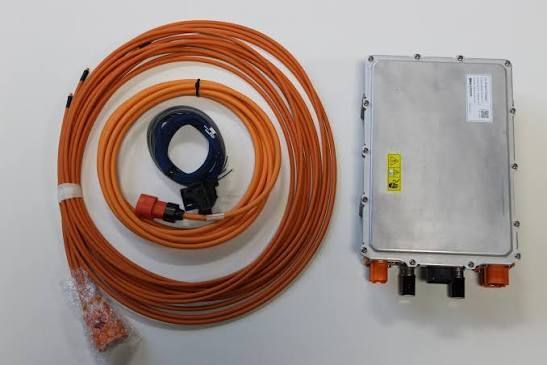
Unlike an external DC fast charger, an onboard charger travels with the vehicle and plays an important role in AC charging. Modern OBC development is moving beyond basic AC-to-DC conversion toward higher power density, bidirectional charging, integrated architectures, advanced semiconductors, improved efficiency, and intelligent energy management.
The International Energy Agency notes that advances in power electronics and battery technology are enabling higher-voltage and faster-charging systems, while smart charging and vehicle-to-grid technologies are creating new possibilities for managing EV electricity demand.
1. What Is an EV Onboard Charger?
An onboard charger is an electronic power-conversion system located inside an EV or plug-in hybrid vehicle.
Its basic function is:
AC Electricity → OBC → DC Electricity → EV Battery
The OBC controls how electrical energy is converted and delivered to the battery while coordinating with vehicle charging controls and safety systems.
An OBC generally contains two major conversion stages:
-
AC-to-DC conversion
-
DC-to-DC conversion
Modern designs can also include power-factor correction, isolation, communication, monitoring, thermal management, and bidirectional power-flow capabilities.
2. Why Onboard Chargers Matter
The onboard charger influences several important aspects of an EV's charging experience.
Key considerations include:
-
Charging power
-
Conversion efficiency
-
Thermal performance
-
Package size
-
Weight
-
Reliability
-
Electrical safety
-
Charging compatibility
-
Communication
-
Power quality
As battery capacities increase and vehicle architectures become more sophisticated, OBC manufacturers are working to deliver greater power within increasingly compact packages.
3. How an OBC Works
A simplified charging sequence looks like this:
Step 1: AC Connection
The vehicle connects to an AC charging source.
Step 2: Input Protection
The charger monitors voltage, current, temperature, and other electrical conditions.
Step 3: Power-Factor Correction
The front-end circuitry can improve the relationship between voltage and current drawn from the AC supply.
Step 4: AC-to-DC Conversion
The AC input is converted into DC electricity.
Step 5: DC Regulation
A DC-DC stage adjusts the electrical characteristics to match the battery's charging requirements.
Step 6: Battery Communication
The charging system exchanges information with vehicle control systems to regulate charging.
Step 7: Continuous Monitoring
Voltage, current, temperature, faults, and other operating conditions are monitored throughout the process.
4. Main OBC Architecture
A conventional OBC can be represented as:
AC Input → EMI Filter → PFC → Isolated DC-DC → Battery
Each stage performs a different function.
EMI Filter
Reduces unwanted electromagnetic interference.
PFC Stage
Power-factor correction helps control the input current waveform and improve power quality.
DC-DC Converter
Converts the intermediate DC voltage into a suitable battery-charging output.
Control System
Coordinates power conversion, communication, diagnostics, and protection.
5. Single-Phase OBC
Single-phase onboard chargers are commonly associated with lower-power AC charging applications.
Their characteristics may include:
-
Simpler architecture
-
Lower power rating
-
Lower component count
-
Compact packaging
-
Compatibility with common AC charging environments
The exact charging power depends on the vehicle, charger design, electrical supply, and applicable standards.
6. Three-Phase OBC
Three-phase architectures can support higher AC charging power.
Potential advantages include:
-
Higher power capability
-
Better utilization of three-phase supplies
-
Improved charging performance
-
Suitability for higher-power applications
Three-phase OBCs can be more complex because of their additional power-conversion requirements.
7. Unidirectional OBC
A unidirectional charger transfers energy in one primary direction:
Grid → Vehicle Battery
This architecture remains important for conventional AC charging.
Its simpler power-flow structure can reduce system complexity compared with bidirectional designs.
8. Bidirectional OBC
Bidirectional onboard chargers allow electrical energy to flow in both directions.
This creates possibilities such as:
-
Vehicle-to-Grid (V2G)
-
Vehicle-to-Home (V2H)
-
Vehicle-to-Load (V2L)
-
Vehicle-to-Vehicle (V2V)
The ISO 15118 family addresses communication concepts associated with charging and discharging, including energy transfer from the EV to a home, load, or grid.
Bidirectional OBCs require additional power-control, protection, communication, and grid-interaction considerations.
9. OBC Power Ratings
OBCs are available across different power levels depending on vehicle architecture.
Common categories can include:
-
Lower-power passenger-vehicle systems
-
Mid-power systems
-
Higher-power AC charging systems
The appropriate rating depends on:
-
Battery voltage
-
Battery capacity
-
Vehicle electrical architecture
-
Intended charging environment
-
Thermal limitations
-
Packaging constraints
Higher OBC power does not automatically mean faster charging in every situation because the vehicle battery and charging infrastructure also impose limits.
10. Silicon, SiC and GaN Semiconductors
Power semiconductor technology is an important area of OBC innovation.
Traditional designs commonly rely on silicon devices, while newer systems increasingly explore silicon carbide (SiC) and gallium nitride (GaN) technologies.
Potential benefits of wide-bandgap semiconductors include:
-
Higher switching frequencies
-
Reduced losses
-
Smaller passive components
-
Higher power density
-
Improved thermal characteristics
Industry technology research identifies GaN and SiC as important areas of OBC development.
11. Silicon Carbide OBC Technology
SiC power devices are attractive for higher-power automotive applications because they can operate efficiently at high voltage and temperature conditions.
Potential advantages include:
-
Lower switching losses
-
High-frequency operation
-
High-voltage capability
-
Compact system design
-
Improved power density
SiC adoption is particularly relevant as EV electrical architectures move toward higher battery voltages.
12. Gallium Nitride OBC Technology
GaN devices can support very high switching frequencies and compact power-conversion designs.
Potential applications include:
-
Compact OBCs
-
Auxiliary power electronics
-
High-frequency converters
-
Low-to-mid-power charging architectures
GaN and SiC should not be treated as universally interchangeable. Their suitability depends on voltage, power level, thermal design, switching requirements, cost targets, and system architecture.
13. Power Density
Power density refers to how much electrical power a system can process relative to its physical size or weight.
Higher OBC power density can help automakers:
-
Reduce packaging requirements
-
Lower component volume
-
Reduce weight
-
Improve vehicle integration
-
Create more space for other systems
This is one reason semiconductor technology and high-frequency switching are important to OBC development.
14. Charging Efficiency
OBC efficiency represents how effectively electrical energy is converted from the AC input into usable battery-charging energy.
Energy losses can occur through:
-
Semiconductor switching
-
Conduction
-
Magnetic components
-
Cooling systems
-
Control electronics
-
Other electrical components
Higher efficiency can reduce heat generation and improve overall system performance.
15. Thermal Management
Heat is an important engineering challenge in high-power OBCs.
Thermal management may use:
-
Air cooling
-
Liquid cooling
-
Heat sinks
-
Thermal interface materials
-
Integrated cooling plates
-
Temperature monitoring
A suitable thermal design helps maintain component reliability and consistent charging performance.
16. OBC Communication
The charger does not operate independently.
It communicates with vehicle control systems to coordinate charging.
Communication can involve:
-
Charging status
-
Voltage
-
Current
-
Battery conditions
-
Fault information
-
Charging limits
-
Energy-management instructions
ISO 15118 provides a framework for high-level communication between EVs and charging equipment, including functions related to charging control, identification, optimization, cybersecurity, and privacy.
17. OBC Safety Features
Safety is a fundamental requirement.
OBC protection systems can monitor:
-
Overvoltage
-
Overcurrent
-
Overtemperature
-
Insulation conditions
-
Short circuits
-
Ground faults
-
Abnormal charging conditions
The IEC 61851 family provides requirements related to conductive EV charging systems, while IEC 61851-21-1 specifically addresses EMC requirements for EV onboard charging systems connected to AC/DC supplies.
18. Electromagnetic Compatibility
OBCs contain high-frequency switching electronics, which can generate electromagnetic emissions.
EMC engineering aims to ensure that:
-
The OBC does not create unacceptable interference.
-
The OBC can operate correctly in its electromagnetic environment.
IEC published the second edition of IEC 61851-21-1 in 2026, with updated EMC provisions for EV onboard charging systems.
19. Integrated Onboard Chargers
Modern EV architectures increasingly combine multiple power-electronics functions.
An integrated charger may combine elements of:
-
OBC
-
DC-DC converter
-
Inverter
-
Motor-control electronics
-
Power distribution
This can reduce:
-
Component count
-
Packaging volume
-
Weight
-
Cooling requirements
However, integrated architectures can also increase design complexity and require careful coordination between different operating modes.
20. Traction-Inverter Integration
Some advanced architectures reuse elements of the vehicle's traction inverter and motor system during charging.
This approach can potentially reduce duplicated hardware.
Research into modern OBC technologies identifies integrated charger-traction architectures as an important innovation area.
21. Multifunctional OBC Systems
Future onboard chargers may perform functions beyond battery charging.
Potential functions include:
-
AC charging
-
DC conversion
-
Auxiliary power
-
Vehicle-to-home energy transfer
-
Vehicle-to-grid operation
-
Vehicle-to-load power
This creates a broader concept of the EV as an energy-management platform rather than simply a vehicle.
22. Major EV Onboard Charger Manufacturers
The global OBC ecosystem includes several types of companies.
Automotive Tier Suppliers
These companies develop power-electronics systems and components for vehicle manufacturers.
Power Electronics Specialists
These companies focus heavily on converters, inverters, charging systems, and semiconductor technologies.
Automotive Technology Companies
Some technology suppliers develop integrated vehicle electronics that include charging functions.
Semiconductor Companies
Semiconductor manufacturers provide the power devices, controllers, sensors, and other components used by OBC developers.
Automotive Manufacturers
Some vehicle manufacturers increasingly develop proprietary power-electronics architectures and charging technologies internally.
Because automotive supply chains change frequently, manufacturer relationships, product portfolios, and technology partnerships should be verified against current company information.
23. What OBC Manufacturers Typically Provide
An OBC manufacturer may contribute:
-
Power-conversion hardware
-
Control electronics
-
Software
-
Thermal-management systems
-
Communication interfaces
-
Diagnostic functions
-
Safety systems
-
EMC engineering
-
Validation
-
Vehicle integration support
The scope varies significantly between suppliers.
24. How Automakers Evaluate OBC Suppliers
Automotive manufacturers may evaluate OBC technologies based on:
-
Efficiency
-
Power density
-
Reliability
-
Thermal performance
-
Packaging
-
Voltage range
-
Charging power
-
Software capabilities
-
Safety
-
EMC performance
-
Manufacturing scalability
-
Supply-chain resilience
Automotive qualification also involves extensive validation under different operating conditions.
25. OBC Applications
OBC technology is used across several vehicle categories.
Passenger EVs
The largest application area includes battery-electric passenger vehicles.
Plug-In Hybrid Vehicles
PHEVs also use onboard charging systems to replenish their battery packs.
Commercial Vehicles
Electric vans, trucks, and other commercial vehicles can use higher-power charging architectures depending on their design.
Buses
Electric buses can use onboard charging alongside other charging approaches.
Specialty Vehicles
Industrial and specialty electric vehicles can also incorporate onboard charging technology.
26. OBC vs DC Fast Charging
These systems should not be confused.
Onboard Charger
The conversion equipment is inside the vehicle.
AC Grid → OBC → Battery
DC Fast Charger
The main AC-to-DC conversion occurs outside the vehicle.
Grid → External DC Charger → Battery
DC fast charging can therefore bypass the vehicle's onboard AC-to-DC converter for the primary charging process.
27. Higher-Voltage EV Architectures
EV manufacturers are increasingly exploring higher-voltage electrical architectures.
Higher system voltage can support:
-
Higher charging power
-
Lower current for the same power
-
Potentially smaller conductors
-
Reduced resistive losses
-
More efficient power transfer
The IEA reports that the first 1,000-volt EV models appeared in 2025 and that higher-voltage architectures are contributing to faster charging developments.
28. Smart Charging
Smart charging adjusts charging behavior according to factors such as:
-
Electricity demand
-
Charging schedules
-
Vehicle requirements
-
Grid conditions
-
Energy-management objectives
OBCs can become part of broader smart-charging systems by communicating with vehicle controllers and charging infrastructure.
29. Vehicle-to-Grid Technology
V2G allows compatible EVs to send electricity back to the grid.
A bidirectional OBC can be a key component in such systems.
Potential applications include:
-
Grid balancing
-
Peak-demand management
-
Distributed energy resources
-
Renewable-energy integration
However, V2G deployment depends on compatible vehicles, charging equipment, communications, regulations, utility structures, and market mechanisms. The IEA notes that commercial V2G offerings for private EV owners began appearing in 2025, but availability remains limited and regulatory frameworks remain fragmented.
30. Vehicle-to-Home and Vehicle-to-Load
Bidirectional systems can also support energy transfer to homes or electrical loads.
V2H
Vehicle-to-home systems can allow an EV battery to provide energy to a compatible home electrical system.
V2L
Vehicle-to-load systems allow an EV to supply electricity to external equipment.
These functions can turn the vehicle battery into a temporary energy resource.
31. Software in Modern OBCs
Software increasingly influences power-electronics performance.
Software can control:
-
Charging curves
-
Power limits
-
Thermal behavior
-
Fault handling
-
Communication
-
Diagnostics
-
Energy management
As vehicles become more software-defined, OBCs increasingly interact with broader vehicle control architectures.
32. Diagnostics and Predictive Monitoring
Modern OBCs can monitor operational data to identify abnormal conditions.
Potential capabilities include:
-
Fault detection
-
Temperature monitoring
-
Voltage monitoring
-
Current monitoring
-
Performance analysis
-
Maintenance diagnostics
Advanced analytics can potentially identify unusual behavior before it develops into a major system failure.
33. Manufacturing Challenges
OBC manufacturers face several engineering and production challenges.
High Power Density
More power must fit into smaller spaces.
Thermal Stress
Higher power creates greater heat-management requirements.
Semiconductor Complexity
Advanced switching devices require sophisticated control and thermal design.
EMC Requirements
High-frequency switching requires careful electromagnetic engineering.
Automotive Reliability
Components must operate reliably across demanding environmental conditions.
Supply-Chain Requirements
Automotive production requires consistent component availability and quality.
34. Testing and Validation
OBC systems undergo extensive testing.
Testing can cover:
-
Electrical performance
-
Thermal performance
-
EMC
-
Environmental conditions
-
Vibration
-
Reliability
-
Safety
-
Communication
-
Fault conditions
The goal is to verify that the charger operates correctly across its intended operating range.
35. OBC Industry Trends in 2026
Several trends are shaping current development.
Wide-Bandgap Semiconductors
SiC and GaN are becoming increasingly important in advanced power-conversion designs.
Bidirectional Charging
V2G, V2H, and V2L capabilities are expanding the role of onboard chargers.
Higher Power Density
Manufacturers are working toward smaller and lighter systems.
Integrated Power Electronics
OBCs are increasingly being combined with other vehicle power-electronics functions.
Higher Vehicle Voltages
Higher-voltage EV architectures are supporting faster and more efficient charging systems.
Intelligent Charging
Communication and software are becoming increasingly important to charging optimization.
36. Future of EV Onboard Chargers
The next generation of OBC technology is likely to focus on:
-
Higher efficiency
-
Greater power density
-
Bidirectional operation
-
Wide-bandgap semiconductors
-
Integrated architectures
-
Advanced thermal management
-
Improved cybersecurity
-
Intelligent charging
-
Software-defined control
-
Multifunctional power conversion
The distinction between an onboard charger and the wider vehicle energy-management system may become increasingly blurred as more functions are integrated.
37. Simple OBC Technology Evaluation Framework
A useful framework is:
Power → Efficiency → Size → Thermal → Safety → Communication → Integration
Power
Determine the required charging capability.
Efficiency
Evaluate conversion losses.
Size
Consider packaging and vehicle integration.
Thermal
Assess cooling and temperature control.
Safety
Review protection and fault-management systems.
Communication
Check compatibility with relevant charging communication requirements.
Integration
Consider how the OBC interacts with the vehicle's broader electrical architecture.
38. OBC Manufacturer Research Checklist
39. FAQs
What is an EV onboard charger?
An EV onboard charger is an electronic power-conversion system installed inside an electric vehicle that converts AC electricity into DC power suitable for charging the vehicle battery.
What is the difference between an OBC and a DC fast charger?
An OBC is located inside the vehicle and performs AC-to-DC conversion during AC charging. A DC fast charger performs the primary AC-to-DC conversion outside the vehicle and supplies DC power to the battery.
What technologies are used in modern OBCs?
Modern OBCs can use power-factor correction, isolated DC-DC converters, digital control systems, silicon or wide-bandgap SiC and GaN semiconductors, thermal-management systems, and advanced communication interfaces.
Why are SiC and GaN important for OBC development?
SiC and GaN can enable higher-frequency switching and improved power density, potentially allowing smaller and more efficient power-conversion systems.
What is a bidirectional onboard charger?
A bidirectional OBC can transfer energy between the vehicle battery and external electrical systems, enabling applications such as V2G, V2H, or V2L when the complete vehicle and charging system support those functions.
What standards are relevant to EV charging systems?
The IEC 61851 family provides requirements for conductive EV charging systems, while the ISO 15118 family addresses high-level communication between EVs and charging equipment. Specific requirements depend on the charging architecture and application.
Conclusion
EV onboard chargers are becoming increasingly important components of modern electric-vehicle architecture.
Their role has expanded from straightforward AC-to-DC battery charging toward sophisticated power-electronics systems capable of supporting higher voltage, greater efficiency, bidirectional energy transfer, advanced communication, and multifunctional vehicle energy management.
For manufacturers and automotive technology developers, the key priorities are increasingly centered on:
Efficiency + Power Density + Reliability + Thermal Management + Software + Bidirectional Capability.
As EV batteries, charging infrastructure, semiconductors, and vehicle electrical architectures continue to evolve, onboard chargers will remain an important area of innovation in the electric mobility industry.
Disclaimer
This article is provided solely for general informational and educational purposes. It does not endorse, recommend, rank, or promote any specific EV onboard charger manufacturer, company, product, technology, supplier, or commercial solution. Manufacturer capabilities, product specifications, partnerships, standards, regulations, technologies, and market conditions can change over time. Technical requirements also vary by vehicle architecture and jurisdiction. Readers should independently verify current specifications, certifications, standards, and technical documentation through authoritative sources before making engineering, procurement, or technology decisions.