Algae Biofuel Production Explained: Process, Technologies, Benefits & Renewable Energy Insights
Algae biofuel is an emerging renewable-energy pathway that uses microalgae, macroalgae or related aquatic biomass as feedstock for producing fuels and other bio-based products
Algae are particularly interesting for biofuel research because some strains can grow rapidly and accumulate significant amounts of lipids, carbohydrates or other useful biomass components. Research also explores cultivation on non-arable land, saline or non-potable water and the use of waste nutrient or carbon streams under suitable conditions.
Unlike conventional oil crops, algae do not necessarily require fertile agricultural land. Their cultivation can potentially be integrated with wastewater treatment, industrial carbon utilization and biorefinery systems.
However, algae biofuel is not yet a simple replacement for conventional petroleum fuels. Large-scale cultivation, harvesting, dewatering, biomass processing and fuel conversion remain technically challenging. The U.S. Department of Energy continues to research ways to improve the productivity and economics of algal biofuel systems.
What Is Algae Biofuel?
Algae biofuel is renewable fuel produced by converting algal biomass or compounds derived from algae into usable energy products.
Depending on the species and processing pathway, algae can potentially contribute to:
- Biodiesel
- Renewable diesel
- Sustainable aviation fuel
- Bio-oil
- Biogas
- Biohydrogen
- Alcohol-based fuels
- Other hydrocarbon fuels
The type of fuel depends on the chemical composition of the algae and the conversion technology used.
Microalgae can contain lipids, proteins and carbohydrates in different proportions, and these characteristics can vary significantly between strains and cultivation conditions.
Why Are Algae Considered for Biofuel?
Algae have several characteristics that make them attractive for renewable-energy research.
Rapid Biomass Production
Some microalgae can grow considerably faster than conventional terrestrial oil crops under suitable conditions.
Potentially High Lipid Content
Certain strains can accumulate lipids that can be processed into fuel intermediates.
Non-Arable Land Potential
Algae can potentially be cultivated without directly competing with conventional cropland in suitable systems.
Alternative Water Sources
Some cultivation approaches can use saline or non-potable water rather than relying entirely on freshwater.
Carbon Utilization Potential
Algal systems can potentially use concentrated carbon dioxide streams as a carbon source, although the overall climate benefit depends on the complete system design and energy requirements.
Multiple Products
An algae facility does not necessarily have to produce only fuel. Proteins, chemicals, fertilizers and other products can potentially be recovered from biomass.
This creates the possibility of an algal biorefinery.
Types of Algae Used in Biofuel Research
Microalgae
Microalgae are microscopic organisms that can grow in aquatic environments.
Examples investigated in research include:
- Chlorella
- Nannochloropsis
- Scenedesmus
- Dunaliella
- Chlamydomonas
Their small size and potentially high growth rates make them important candidates for controlled cultivation.
Macroalgae
Macroalgae are larger forms of algae, commonly referred to as seaweeds.
Unlike many oil-rich microalgae, macroalgae may contain larger proportions of carbohydrates and can therefore be better suited to certain biochemical or thermochemical conversion routes.
Cyanobacteria
Cyanobacteria are photosynthetic microorganisms that are often included in algal biofuel research because of their biological characteristics and potential for producing useful compounds.
Algae Biofuel Production Process
A simplified algae-to-fuel pathway can be represented as:
Strain Selection → Cultivation → Harvesting → Dewatering → Biomass Processing → Conversion → Fuel Upgrading → Final Fuel
Each stage has its own technical requirements.
Step 1: Strain Selection
The process begins with selecting an organism suitable for the intended production system.
Researchers may evaluate:
- Growth rate
- Lipid content
- Carbohydrate content
- Protein content
- Environmental tolerance
- Nutrient requirements
- Temperature tolerance
- Salinity tolerance
- Resistance to contamination
- Ease of harvesting
- Suitability for downstream conversion
A strain with high lipid content is not automatically the best overall option. A practical production strain must also perform well under realistic cultivation and processing conditions.
Step 2: Algae Cultivation
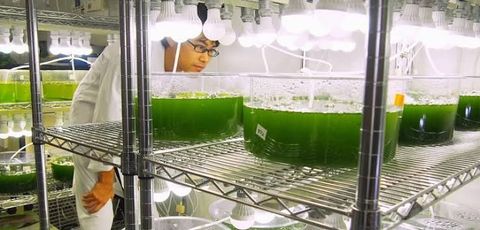
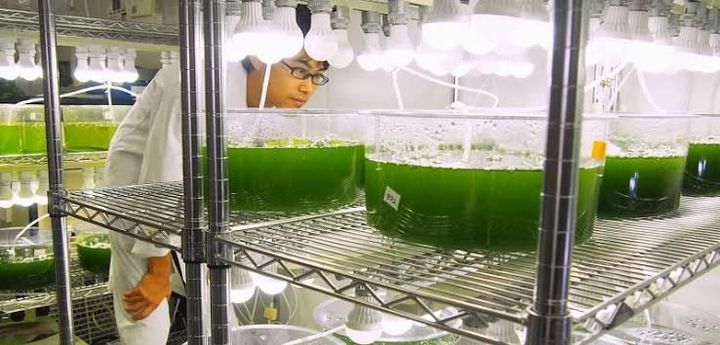
Once an appropriate strain is selected, biomass is cultivated under controlled or semi-controlled conditions.
Important factors include:
- Light
- Temperature
- Carbon dioxide
- Nitrogen
- Phosphorus
- Water quality
- pH
- Mixing
- Contamination control
The U.S. Department of Energy identifies open ponds, attached-growth systems and closed photobioreactors among the cultivation approaches investigated for algal production.
Open Raceway Ponds
Open raceway ponds are shallow cultivation systems designed to circulate algae-containing water.
They can be relatively simple compared with enclosed systems, but they can face challenges involving:
- Contamination
- Evaporation
- Weather fluctuations
- Water management
- Light availability
- Biomass concentration
Closed Photobioreactors
Photobioreactors provide more controlled cultivation environments.
They may use:
- Transparent tubes
- Flat-panel reactors
- Vertical columns
- Other enclosed configurations
Advantages can include greater environmental control and reduced exposure to some contaminants.
However, construction, operation, cleaning, mixing and energy requirements can be significant.
Attached-Growth Systems
Attached-growth systems allow algae to grow on surfaces rather than remaining entirely suspended in water.
One potential advantage is easier biomass recovery compared with very dilute suspended cultures.
These systems remain an active area of research.
Step 3: Nutrient and Carbon Management
Algae require nutrients to grow.
Major nutrients include:
- Carbon
- Nitrogen
- Phosphorus
Micronutrients may also be required.
Research explores whether wastewater streams or other nutrient-containing resources can provide part of these requirements.
Carbon dioxide can also be supplied to cultivation systems.
The U.S. Department of Energy identifies waste nutrient streams and waste carbon dioxide among resources that may be relevant to algal cultivation.
The environmental benefit depends on the complete system, including where the nutrients and CO₂ originate and how much energy is consumed.
Step 4: Harvesting
After sufficient biomass has accumulated, algae must be separated from the cultivation medium.
This is one of the major engineering challenges because microalgae can be present at relatively low concentrations in large volumes of water.
Potential harvesting methods include:
- Sedimentation
- Flocculation
- Filtration
- Centrifugation
- Dissolved-air flotation
- Membrane-based separation
The choice depends on the algae, cultivation system and desired final product.
Step 5: Dewatering
Harvested algae often contain a substantial amount of water.
Removing that water is known as dewatering.
This stage is important because transporting and processing large volumes of water can require substantial energy.
The U.S. Department of Energy identifies harvesting and dewatering as important logistics stages and notes that microalgae can grow at dilute concentrations, creating a significant separation challenge.
Researchers therefore investigate lower-energy methods for concentrating algal biomass.
Step 6: Biomass Processing
Once concentrated, algal biomass can undergo different processing routes depending on its composition and the desired fuel.
Possible approaches include:
- Lipid extraction
- Solvent-based extraction
- Mechanical disruption
- Hydrothermal processing
- Pyrolysis
- Gasification
- Anaerobic digestion
- Fermentation
The processing pathway determines the type of intermediate product generated.
Step 7: Lipid Extraction
For lipid-rich algae, oils can be extracted from the biomass.
Potential extraction methods include:
- Mechanical pressing
- Solvent extraction
- Supercritical-fluid approaches
- Combined mechanical and chemical techniques
- Cell-disruption-assisted extraction
The objective is to recover useful lipids while limiting energy consumption and processing losses.
Step 8: Biodiesel Production
One well-known algae-to-fuel pathway involves converting extracted algal oils into biodiesel.
The basic pathway can be represented as:
Algal Lipids → Oil Extraction → Transesterification → Biodiesel
During transesterification, suitable oils react with an alcohol in the presence of a catalyst to form fatty-acid esters.
The resulting biodiesel can then undergo purification and quality testing.
Step 9: Hydrothermal Liquefaction
Hydrothermal liquefaction is particularly interesting because it can process wet biomass without requiring complete drying.
The process uses elevated temperature and pressure in water to convert biomass into an energy-rich crude-like product commonly called biocrude.
The biocrude can then undergo additional upgrading.
This route can therefore reduce some of the energy burden associated with extensive biomass drying.
Step 10: Pyrolysis
Pyrolysis thermally decomposes biomass in an oxygen-limited environment.
Depending on the operating conditions, products can include:
- Bio-oil
- Gas
- Char
These products can potentially be further processed into fuels or other materials.
Step 11: Anaerobic Digestion
Algal biomass can also be processed through anaerobic digestion.
Microorganisms break down organic material without oxygen and generate biogas.
Biogas typically contains methane and carbon dioxide.
After appropriate purification and upgrading, methane-rich gas can potentially be used as a renewable energy carrier.
Step 12: Fermentation
Algae or algal biomass containing suitable carbohydrates can be processed through fermentation.
Microorganisms convert fermentable sugars into products such as ethanol or other bio-based chemicals.
This pathway is particularly relevant to carbohydrate-rich biomass.
Step 13: Fuel Upgrading
Raw intermediate products are not necessarily ready for direct use in existing engines or aviation systems.
Depending on the pathway, additional processes may include:
- Hydrogenation
- Hydroprocessing
- Distillation
- Purification
- Separation
- Catalytic upgrading
- Fractionation
The objective is to produce a fuel with properties appropriate for its intended application.
Major Algae Biofuel Technologies
| Technology | Main Input | Potential Product |
|---|---|---|
| Lipid extraction + transesterification | Oil-rich algae | Biodiesel |
| Hydrothermal liquefaction | Wet algal biomass | Biocrude |
| Pyrolysis | Dried algal biomass | Bio-oil, gas, char |
| Anaerobic digestion | Organic algal biomass | Biogas |
| Fermentation | Carbohydrate-rich algae | Ethanol and other products |
| Gasification | Biomass | Syngas |
| Hydroprocessing | Algal oils or biocrude | Renewable hydrocarbon fuels |
No single technology is optimal for every algae strain or production system.
Algal Biorefinery Concept
A major idea in algae research is the biorefinery approach.
Instead of extracting only oil for fuel, the entire biomass can potentially be divided into multiple product streams.
For example:
Algal Biomass → Lipids + Proteins + Carbohydrates + Pigments + Other Compounds
Potential outputs can include:
- Renewable fuels
- Protein products
- Nutrient products
- Biochemicals
- Pigments
- Specialty materials
The economic logic is that multiple products can potentially improve the overall utilization of biomass.
The U.S. Department of Energy's algae research includes both fuels and bioproducts and has evaluated systems that could produce sustainable aviation fuel alongside protein products.
Benefits of Algae Biofuel
Potentially High Biomass Productivity
Some algae species can produce biomass rapidly under favorable conditions.
Reduced Competition With Cropland
Algae can potentially be grown on non-arable land, depending on the cultivation system.
Potential Use of Saline Water
Certain species can tolerate saline conditions.
Wastewater Integration
Nutrient-containing wastewater streams may potentially support algae cultivation after appropriate treatment and process design.
Carbon Utilization
Some systems can use concentrated CO₂ streams as part of cultivation.
Multiple Product Streams
An algal biorefinery can potentially generate fuels alongside higher-value products.
Renewable Feedstock
Algae can be continuously cultivated rather than extracted from finite fossil resources.
Environmental Potential
Algae biofuel is often discussed as a low-carbon pathway, but its environmental performance depends heavily on how the complete system is designed.
Important factors include:
- Electricity consumption
- Water use
- Nutrient sources
- CO₂ source
- Cultivation efficiency
- Harvesting energy
- Dewatering requirements
- Conversion efficiency
- Transportation
- Land requirements
- Waste management
- Product recovery
A system that consumes large amounts of energy for cultivation, harvesting and processing may have a substantially different environmental profile from a highly integrated system using low-carbon energy and recycled resources.
Therefore, life-cycle assessment is essential when evaluating algae biofuel.
Major Challenges
1. Cultivation Scale
Producing algae in laboratory conditions is much easier than maintaining reliable production at large scale.
2. Harvesting
Separating small algal cells from large volumes of water can be technically demanding.
3. Dewatering
Removing water efficiently without excessive energy consumption remains a major challenge.
4. Contamination
Open cultivation systems can be vulnerable to unwanted organisms.
5. Light Availability
Photosynthetic production depends on light, which varies with weather, location and season.
6. Temperature Control
Algal growth can be sensitive to temperature.
7. Nutrient Management
Nutrients must be supplied in appropriate quantities without creating additional environmental burdens.
8. Processing Energy
Drying and downstream processing can consume significant energy.
9. Fuel Quality
Different algae produce oils and biomass with different chemical properties, affecting conversion and final fuel characteristics.
10. Scale-Up
Moving from laboratory reactors to large outdoor systems can introduce biological and engineering problems that are difficult to reproduce at small scale.
Algae Biofuel vs Conventional Biofuels
| Feature | Algae Biofuel | Conventional Crop-Based Biofuel |
|---|---|---|
| Feedstock | Algae | Crops, residues or other biomass |
| Growth environment | Aquatic or controlled systems | Primarily terrestrial |
| Cropland requirement | Potentially low | Can be significant depending on feedstock |
| Water requirement | System-dependent | Crop-dependent |
| Production technology | Highly engineered | Often more established |
| Harvesting | Technically challenging | Usually simpler |
| Multiple products | Strong biorefinery potential | Also possible |
| Commercial maturity | Emerging | Varies by pathway |
The comparison depends heavily on the specific feedstock and technology.
Algae Biofuel and Sustainable Aviation Fuel
Aviation is difficult to electrify at large scale, making sustainable aviation fuel an important area of renewable-fuel research.
Algal biomass has been investigated as a potential feedstock for hydrocarbon fuels that can be upgraded into aviation-fuel-range products.
The U.S. Department of Energy has specifically assessed microalgae pathways involving sustainable aviation fuel and other bioproducts.
However, producing aviation fuel from algae at commercially competitive scale requires improvements across cultivation, harvesting, conversion, upgrading and supply-chain integration.
Algae Biofuel in India
India has a research and policy ecosystem that includes algae among potential advanced biofuel feedstocks.
The Department of Biotechnology's Energy Biosciences-Biofuel programme identifies algal biodiesel among next-generation biofuels targeted for research and development.
India's National Policy on Biofuels has also included algae and seaweed among recognized biofuel feedstocks.
Earlier national biotechnology strategies identified algal biofuel research pathways involving oil extraction and transesterification as well as direct conversion to bio-oil.
BioE3 and Algal Technologies
India's BioE3 Policy is designed to strengthen high-performance biomanufacturing and support biotechnology-based innovation.
The policy includes carbon capture and utilization among its thematic areas. Government programmes now specifically describe algal and microbial platforms as potential technologies for converting captured carbon dioxide into fuels, chemicals and materials within integrated biorefinery systems.
This creates an important research direction:
Carbon Capture + Algae Cultivation + Biorefinery + Renewable Products
Algae and Carbon Capture
Algae use photosynthesis to convert carbon dioxide into biomass.
This has led researchers to explore whether algal cultivation can be integrated with concentrated industrial CO₂ streams.
A potential integrated system could look like:
Industrial CO₂ → Algal Cultivation → Biomass → Fuel + Bioproducts
The concept is attractive because carbon management and biomass production could potentially be connected.
However, the actual climate benefit depends on:
- CO₂ capture efficiency
- Energy source
- Cultivation productivity
- Carbon retention
- Fuel processing
- Final fuel use
- Overall life-cycle emissions
Carbon utilization should therefore be evaluated as a complete system rather than assuming that all captured CO₂ automatically produces a climate benefit.
Genetic Engineering and Algae
Researchers are investigating whether biological engineering can improve desirable traits in algae.
Potential targets include:
- Faster growth
- Higher lipid production
- Better environmental tolerance
- Improved carbon utilization
- Better biomass composition
- Easier processing
The U.S. Department of Energy identifies breeding and genetic engineering among approaches being researched to improve algal biomass characteristics.
Genetically engineered algae also raise environmental and regulatory questions, particularly when considering large-scale outdoor cultivation.
India has previously developed regulatory guidance addressing environmental risk assessment for genetically engineered algae intended for commercial biofuel cultivation.
Recent Research and Innovation Directions
Better Algal Strains
Research continues to identify and develop strains with useful combinations of growth rate, biomass composition and environmental tolerance.
Improved Cultivation Systems
Researchers are developing systems designed to improve light utilization, mixing, temperature control and resource efficiency.
Lower-Energy Harvesting
Reducing the energy required to concentrate biomass remains an important research target.
Wet-Biomass Conversion
Technologies such as hydrothermal liquefaction can potentially reduce the need for complete drying.
Integrated Biorefineries
Future systems may produce fuels and higher-value products from the same biomass.
Carbon Utilization
Algal platforms are being investigated as part of integrated carbon-capture and utilization systems.
AI and Process Optimization
Data analytics and AI could increasingly help optimize:
- Growth conditions
- Nutrient dosing
- Light exposure
- Harvest timing
- Biomass composition
- Process efficiency
Future of Algae Biofuel
The future of algae biofuel is likely to depend less on producing only one fuel and more on creating integrated algal biorefineries.
A future facility could potentially combine:
Waste CO₂ + Non-Potable Water + Nutrients → Algae → Fuel + Protein + Chemicals + Materials
This model could improve overall biomass utilization and potentially create several revenue streams.
The most promising applications may emerge where algae production can be integrated with existing industrial infrastructure, wastewater treatment, carbon-management systems or high-value bioproduct manufacturing.
Key Factors for Commercial Development
For algae biofuel to expand substantially, researchers and developers need to address several areas simultaneously:
- Higher biomass productivity
- Lower cultivation energy
- Efficient harvesting
- Lower-energy dewatering
- Better conversion efficiency
- Reliable large-scale operations
- Appropriate strain selection
- Integrated resource recycling
- Competitive life-cycle performance
- Reliable downstream fuel upgrading
The challenge is therefore not one single technological problem. It is a systems-engineering challenge.
Tools and Resources for Learning About Algae Biofuel
Useful resources include:
- Department of Energy algae research programmes
- Department of Biotechnology programmes
- Government biofuel policy documents
- National laboratories
- University bioenergy research centres
- Life-cycle assessment tools
- Biomass characterization methods
- Algal cultivation research databases
- Renewable-energy research publications
- Biofuel technology roadmaps
The U.S. Department of Energy provides dedicated research resources covering algal production, logistics, conversion and bioproduct development.
Frequently Asked Questions
What is algae biofuel?
Algae biofuel is renewable fuel produced by processing algal biomass or compounds derived from algae. Depending on the feedstock and technology, it can contribute to biodiesel, renewable hydrocarbon fuels, biogas and other fuel pathways.
How is algae converted into biodiesel?
A common pathway involves cultivating lipid-rich algae, harvesting and concentrating the biomass, extracting algal oils and converting the oils through transesterification into biodiesel.
Can algae be used to produce sustainable aviation fuel?
Yes. Algal biomass is being researched as a feedstock for pathways that can produce hydrocarbon intermediates and sustainable aviation fuel. The economic and environmental feasibility depends on the complete cultivation and conversion system.
What is the biggest challenge in algae biofuel production?
One major challenge is efficiently harvesting and processing dilute algal biomass. Dewatering can require substantial energy, which is why lower-energy harvesting and wet-biomass conversion technologies are important research areas.
Is algae biofuel commercially widespread?
Algae biofuel remains an emerging technology compared with established biofuel pathways. Significant research continues on cultivation, harvesting, conversion, economics and life-cycle performance. The U.S. Department of Energy continues to support research aimed at improving the scalability of algal biofuels and bioproducts.
Conclusion
Algae biofuel represents an interesting intersection of renewable energy, biotechnology, carbon utilization and biorefinery engineering.
The production pathway can involve strain selection, cultivation, harvesting, dewatering, biomass processing, oil or intermediate recovery, fuel conversion and final upgrading.
Its appeal comes from several potential advantages: algae can grow rapidly under suitable conditions, some systems can use non-arable land or saline water, and algal biomass can potentially be integrated with carbon and nutrient streams.
At the same time, the technology faces major challenges. Harvesting dilute biomass, reducing dewatering energy, controlling cultivation conditions, scaling production and achieving strong life-cycle performance remain important areas of research.
The future may therefore be less about “algae for fuel alone” and more about integrated algal biorefineries that combine fuel production with carbon utilization and higher-value products.
India is also continuing research into algal biodiesel and advanced biofuels, while newer biotechnology programmes are exploring algal and microbial platforms for carbon utilization and biomanufacturing.
As cultivation, biotechnology, process engineering and renewable-energy systems continue to advance, algae could become one component of a broader portfolio of next-generation renewable fuels and bio-based products.
Disclaimer
This article is provided for general educational and informational purposes only. It does not promote any particular company, technology or commercial product. Algae biofuel technologies, regulations, production economics and environmental performance can change as research progresses. Readers should verify current technical, environmental, regulatory and energy information through authoritative government, scientific and industry sources before making decisions based on this topic.